
Over the past decade, the Ayni Institute has dedicated itself to advancing movement-building education. Initially, our primary focus centered on mass protests and the development of the hybrid model. As we refined our mass protest program, it became evident that a broader perspective and diverse foundational theories of change were necessary to effect social transformation. This realization led to the creation of the Movement Ecology framework, which encapsulates the tensions and collaborative power of distinct strategies for social change.
Since our inaugural training in 2017, we have expanded the framework to include distinctions between organizations and movements, as well as an understanding of the cycles that leaders, organizations, and movements experience. We have trained thousands of individuals through workshops and face-to-face sessions on these concepts.
Many participants have leveraged the frameworks to navigate their ecosystems and tackle relevant challenges. Numerous individuals have gained fresh perspectives on their movement conflicts and tensions, while philanthropic leaders have begun to view their portfolios through the lens of movement ecology, identifying gaps in their funding approaches. Others have utilized these concepts to determine the current stage of their movement, bringing forth significant emotional clarity and the possibility for a necessary strategic intervention.
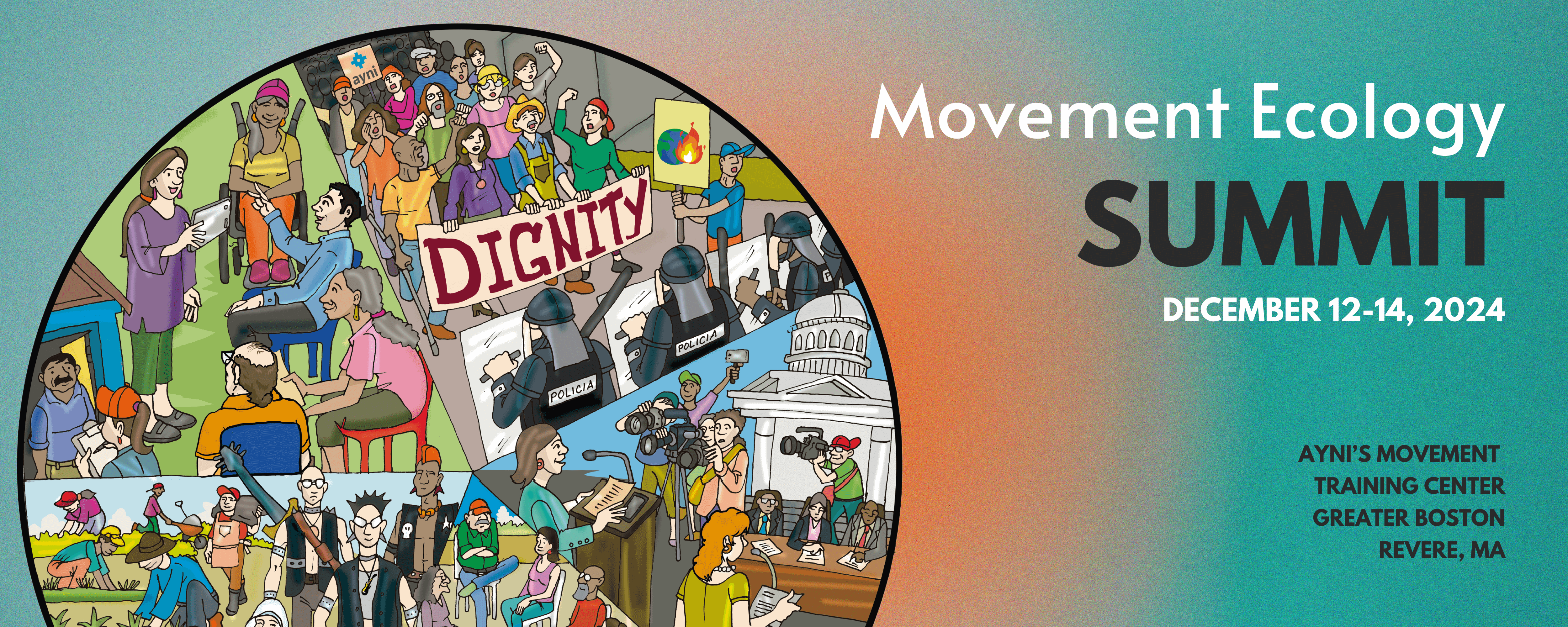
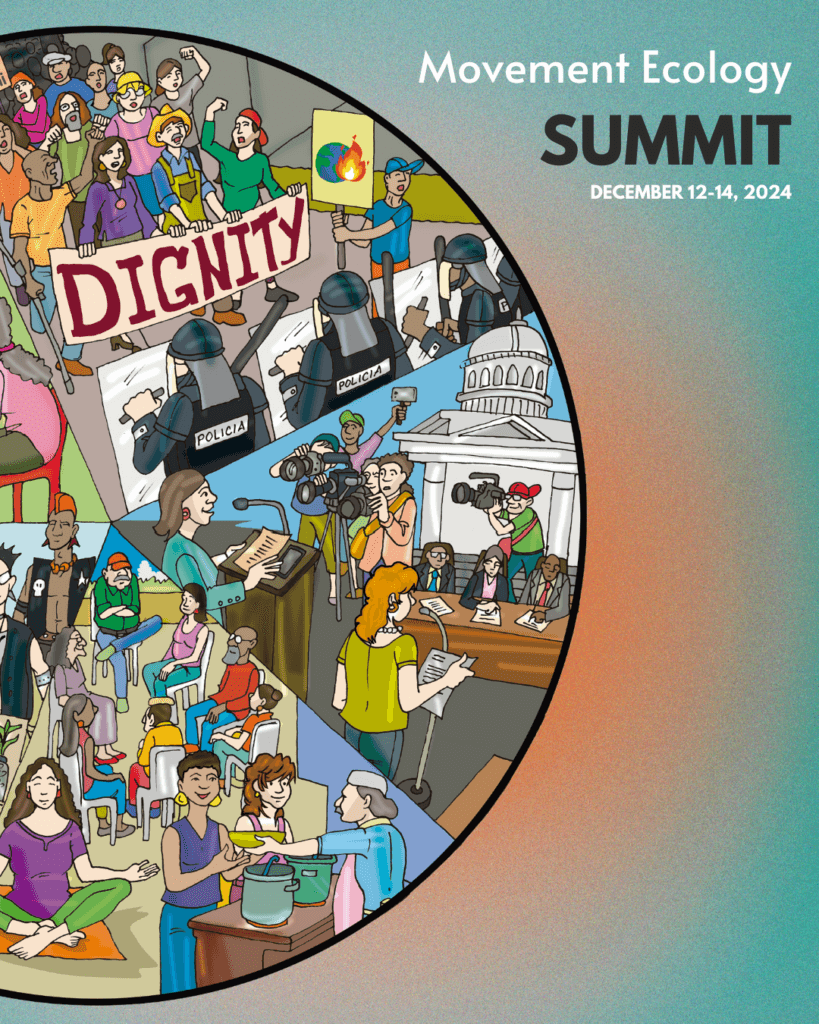
We are now pleased to announce the Movement Ecology Summit, a community of practice for those who recognize the importance of a movement ecosystem perspective, which integrates the foundational theories of change and cycles of change. This summit is designed for individuals who have been employing these frameworks in their work and wish to engage in deeper conversations with peers. Unlike the traditional training sessions that we have offered, the summit will prioritize participants’ themes and questions, structuring sessions around their interests. We will also invite advanced practitioners who have applied the framework to present on topics that resonate with participants.
Potential discussion topics include movement ecology in the context of philanthropy, how to navigate movement winters, and complex models for managing inside/outside game strategies. We will facilitate a process for self-organizing topics and creating panels or small group discussions. We are delighted to host this summit at our new movement training center in Boston, Massachusetts, from December 12 to 14. This event is free to attend, but registration is required. The summit is exclusively for those who embrace an ecological perspective of movements, as taught by the Ayni Institute, and have participated in our workshops.
Over the past decade, the Ayni Institute has dedicated itself to advancing movement-building education. Initially, our primary focus centered on mass protests and the development of the hybrid model. As we refined our mass protest program, it became evident that a broader perspective and diverse foundational theories of change were necessary to effect social transformation. This realization led to the creation of the Movement Ecology framework, which encapsulates the tensions and collaborative power of distinct strategies for social change.
Since our inaugural training in 2017, we have expanded the framework to include distinctions between organizations and movements, as well as an understanding of the cycles that leaders, organizations, and movements experience. We have trained thousands of individuals through workshops and face-to-face sessions on these concepts.
Many participants have leveraged the frameworks to navigate their ecosystems and tackle relevant challenges. Numerous individuals have gained fresh perspectives on their movement conflicts and tensions, while philanthropic leaders have begun to view their portfolios through the lens of movement ecology, identifying gaps in their funding approaches. Others have utilized these concepts to determine the current stage of their movement, bringing forth significant emotional clarity and the possibility for a necessary strategic intervention.
We are now pleased to announce the Movement Ecology Summit, a community of practice for those who recognize the importance of a movement ecosystem perspective, which integrates the foundational theories of change and cycles of change. This summit is designed for individuals who have been employing these frameworks in their work and wish to engage in deeper conversations with peers. Unlike the traditional training sessions that we have offered, the summit will prioritize participants’ themes and questions, structuring sessions around their interests. We will also invite advanced practitioners who have applied the framework to present on topics that resonate with participants.
Potential discussion topics include movement ecology in the context of philanthropy, how to navigate movement winters, and complex models for managing inside/outside game strategies. We will facilitate a process for self-organizing topics and creating panels or small group discussions. We are delighted to host this summit at our new movement training center in Boston, Massachusetts, from December 12 to 14. This event is free to attend, but registration is required. The summit is exclusively for those who embrace an ecological perspective of movements, as taught by the Ayni Institute, and have participated in our workshops.
Tentative Agenda
Agenda subject to changes as we develop the agenda with input from the sponsorship team and based on participants suggestions.
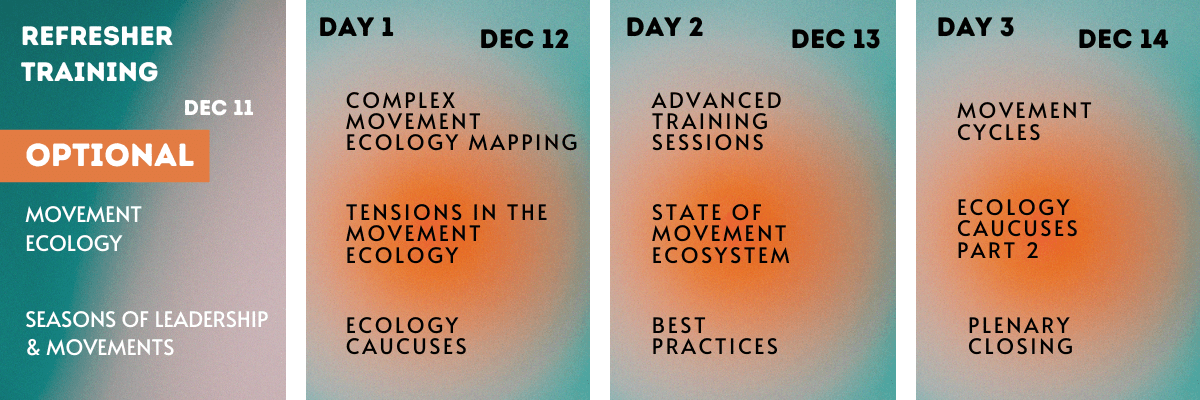
Dec 11th – Refresher Day long Training(Optional)
Dec 12-14th Summit
10am -5pm EST
Wednesday December 11th – Refresher Training (Optional)
10:30am – Foundational Theories of Change and Movement Ecology
1:00pm – Lunch Break
2:30pm – Seasons of Leadership and Movements
4:30pm – Closing & Reflections
5:00pm – Adjourn
Thursday December 12th – First Day
9:00am – Welcome, the World of Movement Ecology and Participant Introductions
10:00am – Complex Movement Ecology Mapping
- Mapping by each Theory of Change subgroups and large group presentation.
1:00 pm Lunch Break
2:30pm – Tensions in the Movement Ecology
- Philanthropy and Movement ecology
- Movement Personal Transformation vs Isolated PT
- Confusing Access with Power – Tensions between in the Inside and Outside Game
- Managing Movement Seasons
4:00pm Break
4:30pm Ecology Caucuses (self organizing)
- by Theory of Change, issue or selective grouping
6:30pm Closing – Large group reflections
7:00pm Dinner
Friday December 13th – Second Day
9:00am – Getting to know each other
10:00am Advanced Training Sessions
- Inside Outside Advanced Strategies – Paul and Mark Engler (training session)
- Modes of Exchange and 21st Interventions – Carlos Saavedra
12:00pm Lunch Break
2:00pm State of Movement Ecosystem and Breakthroughs
- Alternatives & State Relations
- Reflecting on the last decade of Mass Protest Activity
- Labor Movement and the Ecology
4:00pm Break
4:30pm Best Practices to sustain and bridge ecologies
- Funneling people to other theories of change
- Breaking Dogmatism and Isolation
- Integrating Temporal/Informal Organizations with Long Term Movement Institutions
6:30pm end of caucuses
7:00pm Dinner
Saturday December 14th – Last Day
9:00am Breakfast
10:00am Movement Cycles and Seasons Sessions
By issues, season, etc.
12:00am Luch
2:00pm Ecology Caucuses Part 2
4:00pm Break
4:30pm Plenary Closing and Group reflections
6:00pm Adjourn
8:00pm No Talent Talent Show
Current Sponsorship Team
- Gabriella Mora – Krupp Family Foundation
- Chloe Cockburn – Just Impact Advisors
- James Hayes – Ohio Voice
- Andrea James –The National Council for Incarcerated and Formerly Incarcerated Women and Girls
- Paul Engler – Center for the Working Poor
- Michael Poffenberger – Center for Action and Contemplation
- Jasson Perez – Just Impact Advisors
- Dawson Allen – Center for Action and Contemplation
- Daniel Gelbtuch – Episcopal City Mission
- Dylan Lazerow – Wealth Redistribution Center
- Sam La Rocca – The Sunrise Project
Ayni Movement Ecology Trainers
- Carlos Saavedra
- Fhatima Paulino
- Rodrigo Saavedra
- Sergio Hurtado
- Gloribel Mota
Details
Travel & Lodging
The event will take place at our Ayni Movement Training Center located in Revere, MA. Our address is 240 Harris St., Revere, MA 02151. It’s a 10-minute drive from Boston’s Logan Airport.
If you are traveling to the location, here are some lodging suggestions:
- Comfort Inn – located a 7-minute walk from the Training Center
- Various hotels with a range of prices in the surrounding area, due to our proximity to the airport
- Several Airbnb options available if you want to book a shared place with other participants (please indicate your interest on the registration form)
- If you are unable to afford lodging and are open to modest supporter housing, we are happy to connect you with local Ayni supporters who might have a room or couch available (please indicate this on the registration form)
Organization of Summit and Cost
For Participant that registered before September 30th.
We are delighted to offer this summit free of charge for everyone that register early before the deadline of September 30th, 2024.
This event is being organized by the Movement Ecology Training team in collaboration with a group of trusted partner (sponsors) who have been engaging with movement ecology concepts for some time. We will gather suggestions from participants about topics they’re interested in, and then, with our sponsors and others, design group sessions and training modules to meet the collective’s needs. We will also leave space in the agenda for emergent ideas, as things often change as we approach the event date.
This event will be organized using a gift economy model. We will work with the Ayni team to create a budget for all foreseeable expenses. We don’t want cost to keep anyone from participating. However, as a small institute, we will need support from others to cover food, venue, and other expenses. If you’re interested in supporting the gathering, you can either donate here or contact Sergio Hurtado at sergio@ayni.institute.
Registration Process
The only requirement for this event is for you to have been a participant in either a Movement Ecology or Season of Leadership workshop or training, and to be a practitioner who understands the necessity of using these frameworks.
We aim to keep this gathering to under 80 participants unless there is sufficient demand that necessitates expansion. We will be reaching out to all registrants from September through October to confirm that you have attended a workshop, endorse the framework, and are committed to attending. If we do not hear from you after making a few attempts, we will revoke your registration. Please be mindful of responding to us once we start the confirmation process.
Since this is a gift economy-based summit, and we want to use our resources mindfully, we ask you to please only register if you know that you will be able to attend. We will close the registration once we reach our 80 participant limit on a first-come, first-served basis.