
Note: The 2026 Movement Strategy Training has been postponed. Please fill out the interest form, and we will keep you updated with any new dates and information.
At a time when we’re seeing reactionary politics and fear-based narratives taking hold, and where we’re facing serious setbacks on climate change, immigrant rights, and increased criminalization of communities, we need to think differently about how we build social movements that can contend with power structures in our world.
When times get tough, our movements have a tendency to only play defense. We get caught up in protecting what we have, supporting traditional organizations, and just trying not to lose ground. We absolutely need to defend our communities and our progress, but we also need to go on the offensive.
Civil resistance has shown us, time and again, that ordinary people can shift the course of history when they act together strategically. From mass strikes and boycotts to coordinated acts of noncooperation and nonviolent strategic disruption, civil resistance isn’t just about protest, it’s about building collective power capable of challenging unjust systems and creating openings for transformation. And that is just one of so many strategies people are utilizing to make change.
There are millions of people in the world who are ready to be part of something bigger. People who are fed up with our unjust economic system, who want to do something about creating a livable planet, and who believe we can build something better.
That’s exactly why we created the Movement Strategy Training.
What This Training Is Really About
This isn’t just another workshop. We’re creating an immersive experience that combines big-picture movement theory with practical, on-the-ground strategy development. Yes, we need to respond to what’s happening right now in 2025, but we also need to be smart about planning for the openings and opportunities that will emerge in 2026, 2027, and beyond. We need to be ready for those moments when the current power structure shows its weaknesses.
The Movement Strategy Training offers:
Strategic Frameworks: Dive into the dynamics of movements, explore cycles, power structures, and distributed organizing.
Practical Tools: Learn proven methods from historical and contemporary movements to build campaigns, navigate conflict, and withstand repression.
Actionable Plans: Engage in hands-on exercises to craft strategies tailored to your movement’s goals and challenges.
This training balances analysis with practical strategies to empower participants to build impactful, lasting movements.
Here’s How It Works
Every day, we’re going to combine theory with practice. We’ll look at best practices from historical movements and learn from contemporary leaders and trainers. You won’t just be sitting and listening; each day includes practical exercises and planning time where you’ll work on your movement strategy.
You’ll tackle real questions like:
How do we structure our campaigns?
What kind of organizational structures do we need?
How do we handle conflict and repression?
How do we build real power in our specific context?
The Agenda
Just remember, this is a tentative agenda for the training. As we welcome new participants and explore their needs, we will tailor the agenda to reflect the needs of the majority, so it is subject to change.
Day One: Theories of Change and Social View of Power
We’re starting with foundations because we need to be clear about how change actually happens. We’ll look at different approaches of social change- mass protest, structure-based organizing, personal transformation – and really understand what each brings to the table. Then we’ll dig into different theories of power, especially focusing on what it means to hold a social view of power and change.
Day Two: Popular Support and Movement Cycles
This is crucial – we’re going to talk about what actually makes movements move: popular support. What’s the difference between passive and active support? How do you build it? How do you keep it? We’ll also map out movement cycles – the ebbs and flows that every movement goes through – and figure out how to navigate each stage effectively.
Day Three: Messaging, Values, and Narrative
Let’s be real – sometimes we get stuck talking to ourselves in movement spaces. We use language that most people don’t understand, or we go so broad that we lose our core values. We’re going to work on finding that sweet spot – how to communicate in ways that both mobilize masses of people AND stay true to our movement values.
Day Four: Campaigns, Tactics, and Repression
This is where we get practical. We’ll break down how campaigns really work, explore hundreds of different tactics (yes, hundreds – we want you to get creative!), and get real about dealing with repression. We know repression is evolving, so we need to be ready for what’s coming and have solid approaches for dealing with it.
Day Five: Distributed Organizations and Systems
One of the biggest challenges movements face is structure – how do we build organizations that allow for real autonomy while maintaining unity? We’ll look at decentralized structures that actually work, exploring everything from group development to training systems to communications flows.
Day Six: Managing the Ups and Downs
Look, movement work is complex. We’ll get into managing all kinds of tensions – between different theories of change, within coalitions, between personalities. We’ll talk about dealing with burnout and exhaustion. And here’s something people often miss – we’ll discuss how to handle success because sometimes victory can create more challenges than defeat.
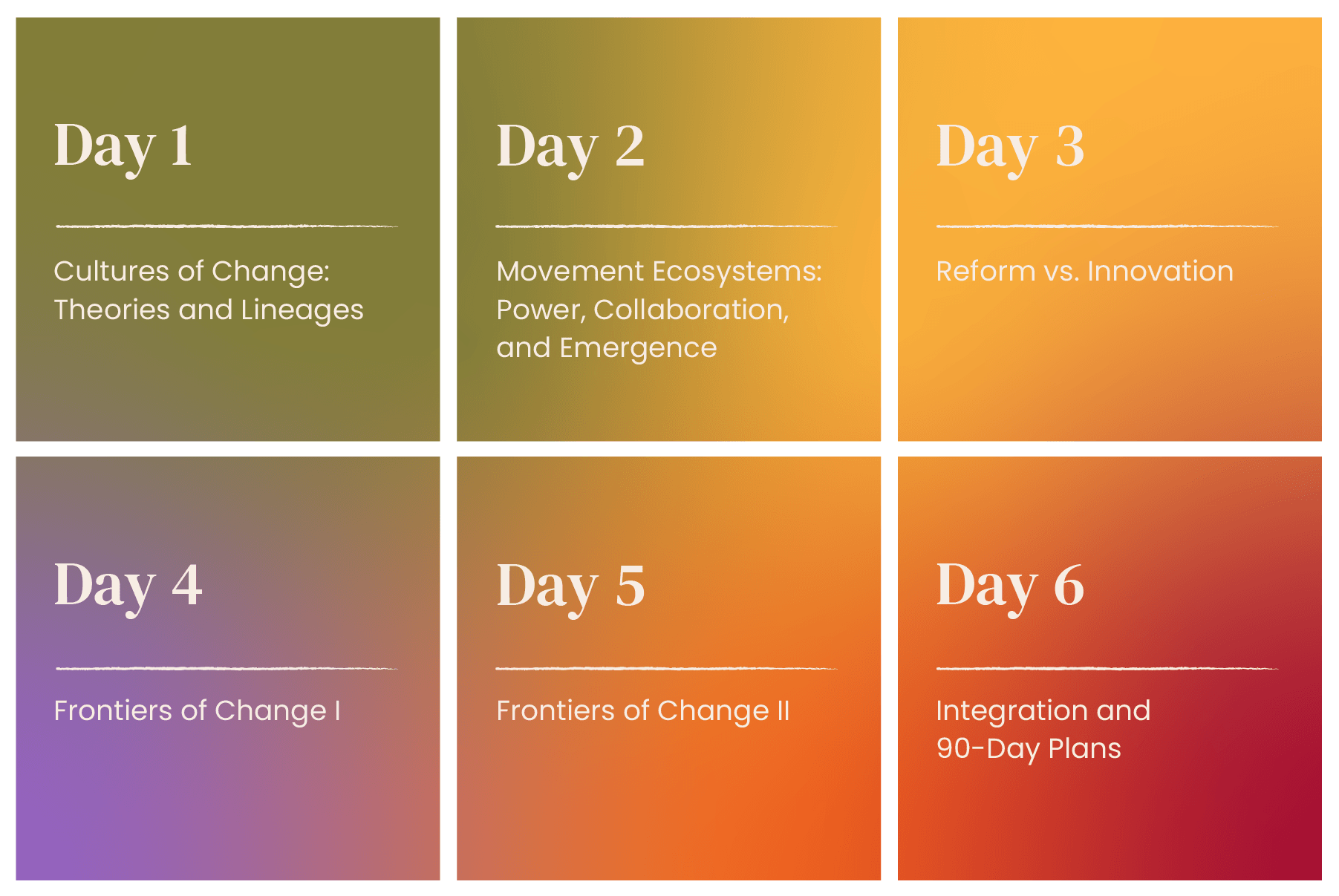
Day One: Cultures of Change: Theories and Lineages
We begin by exploring how change happens and the diverse cultures that shape our approaches to it. Through the Movement Ecology Framework, we revisit and deepen our understanding of five theories of change, not as abstract models but as living narratives embedded in us, approaches in our organizations, and culture in our movements.
Core topics include:
The five cultures and theories of change (as a continuation of prior learning)
Mapping our organizational and personal alignment with each theory
How theories of change shape strategies, relationships, and identity within movements
Purpose: Develop a shared language and deeper literacy around how change manifests across traditions of struggle.
Day Two: Movement Ecosystems: Power, Collaboration, and Emergence
We zoom out to see movements as living ecologies, complex systems with interdependent actors and strategies.
Core topics include:
The Movement Ecosystem framework and levels of collaboration
Social vs. Monolithic Views of Power
Simple and Complex Collaborations
Emergent properties of movement-building, how ecosystems evolve over time
Purpose: Cultivate an ecological perspective on movements, identify points of convergence and conflict, and understand what fuels movements to evolve and grow.
Day 3: Reform vs. Innovation
We explore the tensions between reforming existing systems and incubating new ones.
Core topics include:
The Innovator’s Dilemma in social change
Organizational and Movement DNA and processes like frontloading, incubation, inoculation, and replication
Organizational Cultural Assessment: how much can I innovate or change my organization?
Purpose: Understand the limitations and opportunities of innovation in organizations and learn models of scale building.
Days 4 & 5: Frontiers of Change I & II
In Days 4 and 5, we shift from analysis to practice, exploring the emerging frontiers of change, the places where strategy meets experimentation and where movements are actively inventing what’s next. These two days are structured around participant-centered tracks, allowing each person to go deeper into areas most relevant to their context and field of work.
Potential tracks include:
Campaign Development: Designing campaigns that move the public and build power
Co-Governance: Building power through outside strategies and governing with the outside game in mind
Mutual Aid & Peer-to-Peer Systems: Strengthening community resilience and personal development through networks of mutual support
Civil Resistance & Organizing Under Authoritarian Conditions: Exploring strategic nonviolence, escalation dynamics, and lessons from global movements
Meta-Strategy & Ecosystem Alignment: Understanding long-term coordination across movements, “the meta-left” conversation
Scaling Programs & Mass Training Architectures: Developing structures that allow growth without losing what’s essential
Purpose: To explore the frontiers of movement practice, connecting innovation, governance, and scale, and to equip participants with frameworks and peers to continue experimenting beyond the training.
Day 6: Integration and 90-Day Plans
The final day centers reflection, integration, and forward planning. Participants revisit key frameworks, surface tensions in application, and design practical next steps.
Core elements include:
Assessment of organizational readiness and leverage points
Mapping tensions between theory and practice
Drafting 90-day action or learning plans
Collective closing ritual for integration and commitment
Purpose: To give space for reflection and making needed decisions.
Day Six: Managing the Ups and Downs
Look, movement work is complex. We’ll get into managing all kinds of tensions – between different theories of change, within coalitions, between personalities. We’ll talk about dealing with burnout and exhaustion. And here’s something people often miss – we’ll discuss how to handle success because sometimes victory can create more challenges than defeat.
Days 1–3: Movement Strategy Foundations
The first three days focus on building a shared foundation for how change unfolds across movements. We explore the cultures and theories of change that shape our work, seeing them as living traditions embedded in our organizations and histories of struggle. Through a movement ecology lens, we view movements as interconnected ecosystems that evolve through collaboration, conflict, and emergence. We also examine the tension between reform and innovation, studying how new systems and strategies arise from within and alongside existing structures. Participants learn to read the landscape of power, identify leverage points, and time their interventions for maximum impact, leaving with a clearer map of how their work fits within the larger movement ecosystem and a refined understanding of how transformation happens in practice.
Days 4–6: Project & Initiative Development
The final three days shift from analysis to design as participants move into the frontiers of change, where ideas meet experimentation and movements prototype the futures they seek to build. Each participant selects a track relevant to their context, such as campaign development, co-governance, mutual aid systems, civil resistance, or large-scale training architectures, using these as laboratories for applied strategy. The training concludes with integration and forward planning, where participants assess organizational readiness, identify leverage points, and craft 90-day action plans.
Who this is For
- Movement Builders: Leaders and organizers driving social movements and initiatives.
- Movement Supporters: Funders, communicators, researchers, and others strengthening movement infrastructure.
If you’re thinking about applying, ask yourself:
- Are you actively working to build social movements?
- Are you trying to engage thousands of people around critical issues?
- Are you supporting movements through research, advocacy, or philanthropy?
- Do you want to understand how to make movements more effective?
If you’re nodding your head, this training is for you.
What We Need From You
Let’s be clear about expectations:
- You need to commit to all six days, from 9am Monday through 6pm Saturday.
You need to believe in movements as a craft, something we can study, understand, and get better at regardless of the conditions we are facing.
You need to bring a spirit of respect and openness. We’re going to have people from different backgrounds, working on different issues, and that diversity is a strength.
The Practical Stuff
General Details and Application Deadline
Dates: Monday, June 22 (9:00 AM) to Saturday, June 27 (6:00 PM)
Location: Ayni Training Center, Boston, MA (10 minutes from Logan Airport)
Daily Schedule: Full days from 9:00 AM to 6:00 or 7:00 PM, with breaks and meals included.
Food: Breakfast, lunch, snacks, and dinner are provided.
Application Deadline:
Priority Deadline: March 15th
Final Deadline: April 26th
Travel, Lodging and COVID Precautions
The event will take place at our Ayni Movement Training Center located in Revere, MA. Our address is 240 Harris St., Revere, MA 02151. It’s a 10-minute drive from Boston’s Logan Airport.
If you are traveling to the location, here are some lodging suggestions:
- Comfort Inn – located a 7-minute walk from the Training Center
- Various hotels with a range of prices in the surrounding area, due to our proximity to the airport
- Several Airbnb options available if you want to book a shared place with other participants (please indicate your interest on the registration form)
- If you are unable to afford lodging and are open to modest supporter housing, we are happy to connect you with local Ayni supporters who might have a room or couch available (please indicate this on the registration form)
COVID Precautions: We ask that everyone test for COVID before arriving and if you have any symptoms, to please notify us and refrain from coming, since we have folks who are immunocompromised on our team. Thank you in advance!
Training Cost Pricing Guide
Training Fee Structure
At our organization, we believe that financial barriers should not prevent anyone from accessing our trainings. To ensure accessibility, we use a tiered cost model, where fees are adjusted based on individual income or organizational budget. Higher tiers help subsidize lower tiers, making the training available to a broader community.
There Are Two Payment Options:
1) Individual Payment:
If you are paying out of pocket, you will be charged the individual rate based on your selected tier. For example, if you qualify for the Reciprocity tier, your tuition is $400, and that is the total amount you pay.
2) Organizational Payment:
If your participation is funded by an organization, your fee depends on your organization’s budget tier.
For example, if your organization qualifies for the Sustainer tier, the cost is:
- $900 for one participant
- $2,700 – $3,600 for a group of three to four participants
For more details on where you or your organization fit within these tiers, please refer to the chart below and the two Tiers In-Detail Sections.
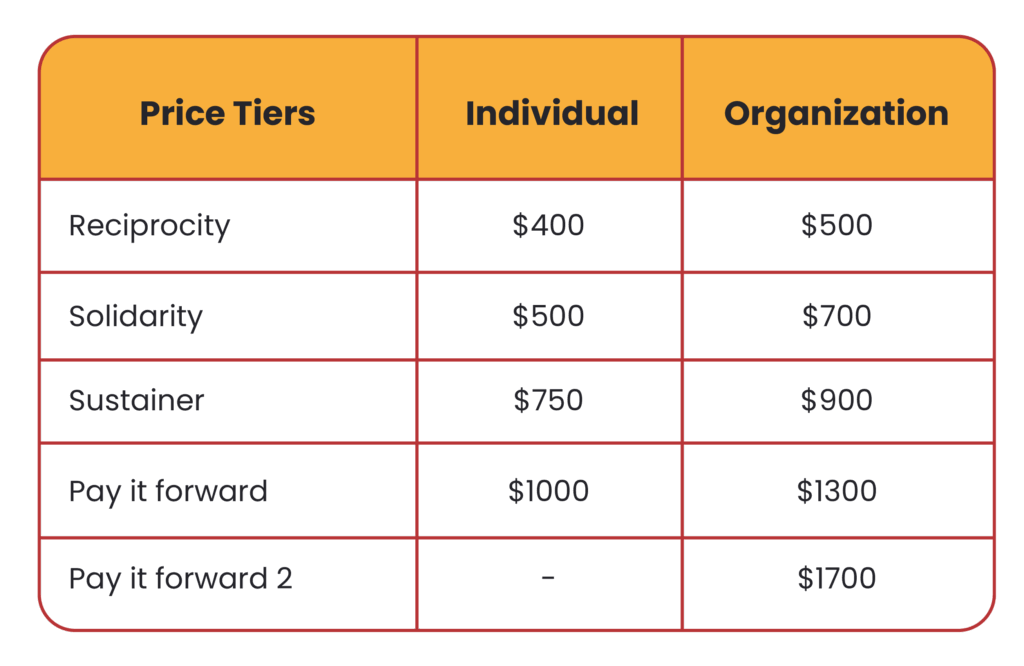
Organization Pricing Tiers In-Detail
If you are an emerging, nascent organization within your first 3 years, or under resourced with a budget under $150K, your organization falls under this tier.
You are a small to midsize organization with a budget ranging from $150 – $600 K.
Your are an established organization with a budget within the range of $600 – $1.5 million annually.
You are a stable organization with a budget of $1.5million+.
You are a stable organization with a budget of $5million+.
Individual Pricing Tiers In-Detail
Essentially, you have a hard time meeting your basic needs, you work in social change, or are not affiliated with an organization that can sponsor your enrollment.
Stability on Meeting Basic Needs
- I am unemployed or underemployed
- I frequently stress about meeting basic needs & don’t always achieve them
- I rent lower-end properties or have unstable housing
- I don’t have transportation and/or have limited access to a car
- I cannot afford a vacation or have the ability to take time off without financial burden
Wealth & Debt
- I have debt and it mostly prohibits me from meeting my basic needs
- I have no access to savings
- I qualify for government assistance including food stamps & health care
- I have no or very limited expendable income
- I rarely buy new items because I am unable to afford them
- I do not have or expect to inherit money or property
Education & Immigration Status
- I may not have completed high school or GED, or have limited experience with higher education
- I do not have U.S. Citizenship & do not qualify for any government assistance
You can meet some of your basic needs but don’t have long-term security. If you identify with all or the majority of the indicators please select this tier.
Stability on Meeting Basic Needs
- I rent lower-end properties but have stable housing
- I have access to transportation or have access to a car
- I am employed, underemployed, living paycheck to paycheck
- I have limited amounts of expendable income
- I don’t often buy new items (but I can if needed) and I thrift other items
- I have very limited funds for a vacation
Wealth & Debt
- I have debt which could prohibit me from meeting my basic needs, but I am currently able to make monthly payments
- I might have access to government assistance or subsidies
- I might have a little savings saved up
- I do not have a safety net composed of “financially stable” or wealthy family and friends
Education & Immigration Status
- I might have attended a community college or public higher education institution
- I have not attended private education institutions or have an advanced degree
- I have work permit, TPS or employee sponsorship providing me some income to meet my basic needs
This is for individuals who are able to meet their basic needs and have the support for long term financial stability and ability to pay the actual cost without being financially burdened.
Stability on Meeting Basic Needs
- I own or lease a used or lower end car & have access to transportation
- I am employed/have stable income
- I have access to health care (private or public) & don’t rely on government benefits
- I can take a vacation annually or every few years without financial burden
- I qualify for first time home buyers programs or subsidies to purchase a house or property
Wealth and Debt
- I might have debt but don’t usually stress about meeting my basic needs and regularly achieve them
- I have access to financial savings
- I have expendable income
- I am able to buy mostly new items
- I am expecting to inherit small amounts of money or property
Education and Immigration Status
- I have U.S. Citizenship or other citizenship that allows me freedom of mobility
- I might have private education institutions or have an advanced degree
This tier is for higher-earning individuals that can meet all of their basic needs, have support for long term financial stability, has built wealth with the ability to share their abundances.
Stability on Meeting Basic Needs
- I am comfortably able to meet all of my needs & desires
- I own my home or property OR I rent a higher-end property
- I own or lease a higher end or multiple car(s)
- I have regular access to health care
I am employed or do not need to work to meet my needs - I have a safety net composed of “financially stable” or wealthy family and friends
Wealth and Debt
- I have access to financial savings & access to wealth
- I have an expendable income
- I can always buy new items
- I can afford an annual vacation or take time off when needed
- I own property or multiple properties
- I have and/or expect to inherit significant money or property
Education and Immigration Status
- I have attended a private education institution or have an advanced degree
- I have U.S. Citizenship or other citizenship that allows for mobility around the world
After reviewing the tier qualifiers, please select the one you self-identify with and the price rate that applies to your tier. Things to consider when reviewing the following tiers:
The following is our guide to help you think about what rate you qualify for and doesn’t encompass all of your personal factors.
Please make sure to consider any personal financial responsibilities; work, family, health, etc. when selecting your tier.You do not have to meet all the factors to fall into a category. Instead, these should be guideposts to help you think about what tier you qualify for. If most of the qualifiers describe you or your situation, you are in that tier.
Movement Strategy Training Interest Form
Note: The 2026 Movement Strategy Training has been postponed. Please fill out the interest form, and we will keep you updated with any new dates and information.