

Seasons of Leadeship
the cyclical patterns that exist in our leadership and social movement organizations
Seasons of Leadership
The cyclical patterns that exist in our leadership and social movement organizations.
The Importance of Seasons
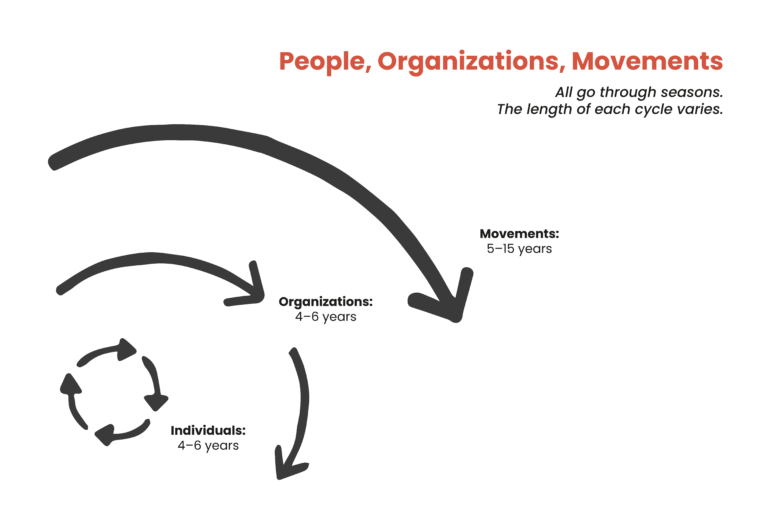
The Seasons framework is an approach that draws inspiration from spiritual and indigenous traditions, which the Ayni Institute has adopted to help us understand the cyclical patterns of our personal development, organizational growth, and broader societal shifts. This framework uses the metaphor of seasons to guide us through the four phases (or seasons) of leadership cycles: winter, spring, summer, and fall.
Attuning to our Seasons and Cycles help us determine when it is the right time to do the right thing. We refer to this strategic capacity, a term we borrow from legendary organizer Marshall Ganz. Like everything else, strategic capacity is a muscle that our organizations need to cultivate among all its members so that we can do the right thing at the right time. When we aren’t attuned to our Seasons and cycles, we may be doing the right thing at the wrong time, or doing the wrong thing at the right time. Regardless, we know from studying history that the rewards when we do the right thing at the right time can be massive, while the costs of not doing so can be equally as detrimental to the goals we are pursuing.
An Overview of the Seasons Framework
Winter
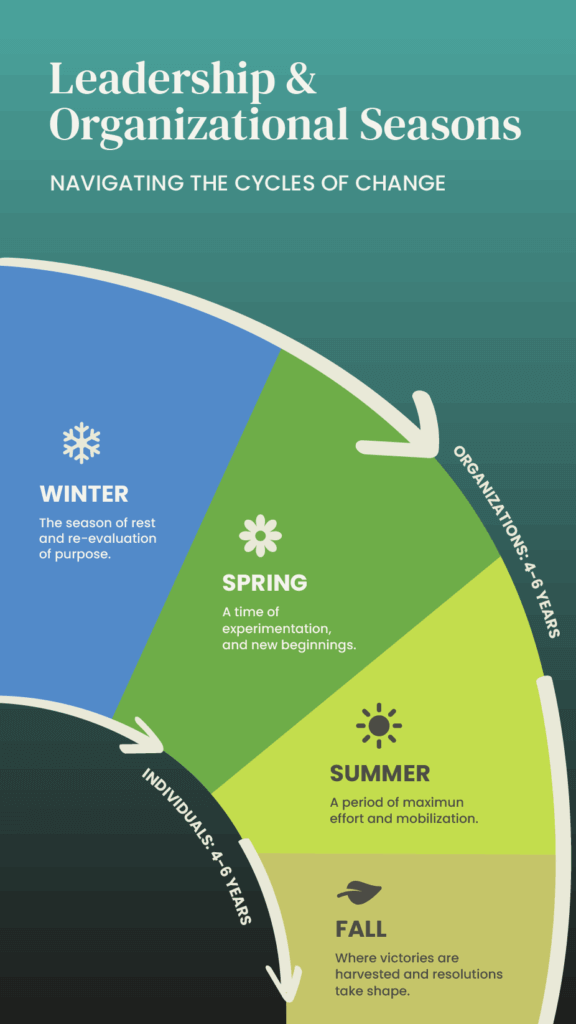
The leadership cycle is a process that involves different seasons, each of which is characterized by unique elements. Winters are a time to be internally focused and are defined as periods for regeneration and re-evaluation. This is a time for processing the previous leadership cycles and developing insights and revelations about our own leadership (how we’ve tried to respond and how we want to respond). Winters oversee the process of recommitting to our own leadership cycles and thus birth the new cycle. They are the space where the old is dying, and the new is just beginning to emerge.
We believe that winters are an essential part of the leadership cycle, and we must honor this time, just as we honor and respect all the other seasons. The reality is that we all go through winters, and many of us experience unplanned ones. A lack of rest and re-evaluation can lead to burnout or repeating the same mistakes.
Most of us traverse these winters unintentionally and, most importantly, without support. This can lead to winters that never end, which can be dangerous and cause more damage to our leadership. To have successful winters, we need to strike a balance between resting enough to feel rejuvenated and going through a reflection process to understand the kind of leader we need to be. If we strike this balance properly, we can receive the revelations and breakthroughs that can give birth to a spring.
Spring
Spring is a season of new beginnings, personal growth and experimentation. It marks the start of a new cycle, emerging from the darkness of winter. It’s a time of excitement and openness, and a chance to recommit to our goals. However, just like every season, spring is not isolated from the rest of the leadership cycle. The degree of excitement and openness we feel in spring depends on how deep and intentional our winter was. A successful spring involves:
- Finding less resistance within ourselves to try new things.
- Taking on responsibilities.
- Approaching things with curiosity and humility.
Failing to have a successful spring could lead to rushing into the next season too soon, causing us to feel overwhelmed. It may also prevent us from experimenting, taking risks, and missing out on innovation and new ways of thinking that our organizations and movements desperately need. It’s important to take the time necessary to have a good spring and to embrace the openness and opportunities it brings.
Summer
The summer is a time of high energy, characterized by movement and intensity, and is primarily about fulfilling our different missions. It is a time for maximum activity, for a clear sense of purpose and direction that is full of determination. However, to find balance during the summer, we must be moved by our energy, but not let it burn us out as we try to do too much. To understand this balance, we must recognize that summers end and cannot be prolonged, no matter how much we may wish for them to be eternal. To have a successful summer, we must dedicate our time to focus on a limited number of projects or areas. This requires saying no to things that could pull our focus and attention in different directions. We must view it as a marathon, not a sprint, which means we must know when to bring consistent high energy in punctuated forms and at the right moments, and to rest in others.
Fall
Lastly, there is fall, which is the season of harvesting the fruits from work during the summer and also starting to slow and break down certain elements to prepare for the winter. The fall is a time to reap the rewards of summer; it is the culmination of the advances and victories that may have been built during the last season and seeded in the spring. Typically when leaders find themselves in the fall season, they feel that their energy isn’t the same as it was during summer may feel a decrease in energy compared to the summer, and it’s essential to respect this natural dip. Attempting to push through can lead to burnout, so it’s crucial to understand that fall is a relay race, and we need to transition some roles or pass the baton to others. The wisdom of fall is about knowing and understanding that cycles come to an end and about actually sustaining the fall to give ourselves time to prepare for winter, which is around the corener.
As stated previously, we are interested in applying this perspective to our leadership, our organizations, and the social movement we belong to. We can also apply this framework to different social change traditions and broader social and historical cycles. This will help us to conceptualize, appreciate and protect the ebbs and flows, the ups and the downs that occur throughout our time with this work — and it informs what we should be doing with intentionality, depending on the season we find ourselves in. This consciousness and groundedness in the seasons of our leadership can then help us be more strategic about how we are using our time and energy and direct our focus in the right direction.
In this regard, by engaging with the resources below, you too can start to be aware of your seasons so that you begin to think about how to maximize the results and do the right thing at the right time.
Resources
Leadership and
Organizational Seasons Mini-Course
The “Leadership & Organizational Seasons” framework is centered around the recognition and understanding of the cyclical nature inherent in leadership roles and social movement organizations. These cycles, or ‘seasons,’ are vital in helping us comprehend, appreciate, and safeguard the natural fluctuations — the ebbs and flows — that we encounter throughout our involvement in social change work.
In our journey, we often oscillate between periods of high external activity and engagement, where our energy is directed outward, fueling actions and campaigns. Conversely, there are phases where our focus turns inward, appearing dormant to those outside, yet internally, we are engaged in reflective, strategic, and restorative activities. This internal focus is not a lack of progress but rather a crucial phase for recalibration and renewal.
Every stage of this cyclical process serves a distinct purpose and comes with its unique gifts and limitations. These stages are instrumental in shaping our approach to leadership, organizational development, and movement strategies. Recognizing and embracing these cycles allow us to align our actions with our corresponding season, supporting our effectiveness and well-being.
In this mini-course, we delve deeply into the concept of leadership and organizational seasons. We explore:
- Identifying Different Seasons: Understanding the characteristics of each season in leadership and organizational contexts.
- Navigating Seasons Effectively: Learning how to adapt our strategies, leadership styles, and organizational practices to the current season.
- Maximizing the Potential of Each Season: Harnessing the unique opportunities and managing the challenges that each season presents.
- Integrating Seasonal Awareness: Applying this understanding to enhance our leadership impact and organizational effectiveness.
By engaging with this course, participants will gain insightful perspectives and practical tools to navigate the dynamic cycles of leadership and organizations. This knowledge empowers leaders and organizations to not only survive but thrive through the changing seasons of social change work.
Article on Waging Nonviolence
Movements and leaders have seasons:
It’s important to know which one you are in
Article on
Waging Nonviolence
Movements and leaders have seasons:
It’s important to know which one you are in
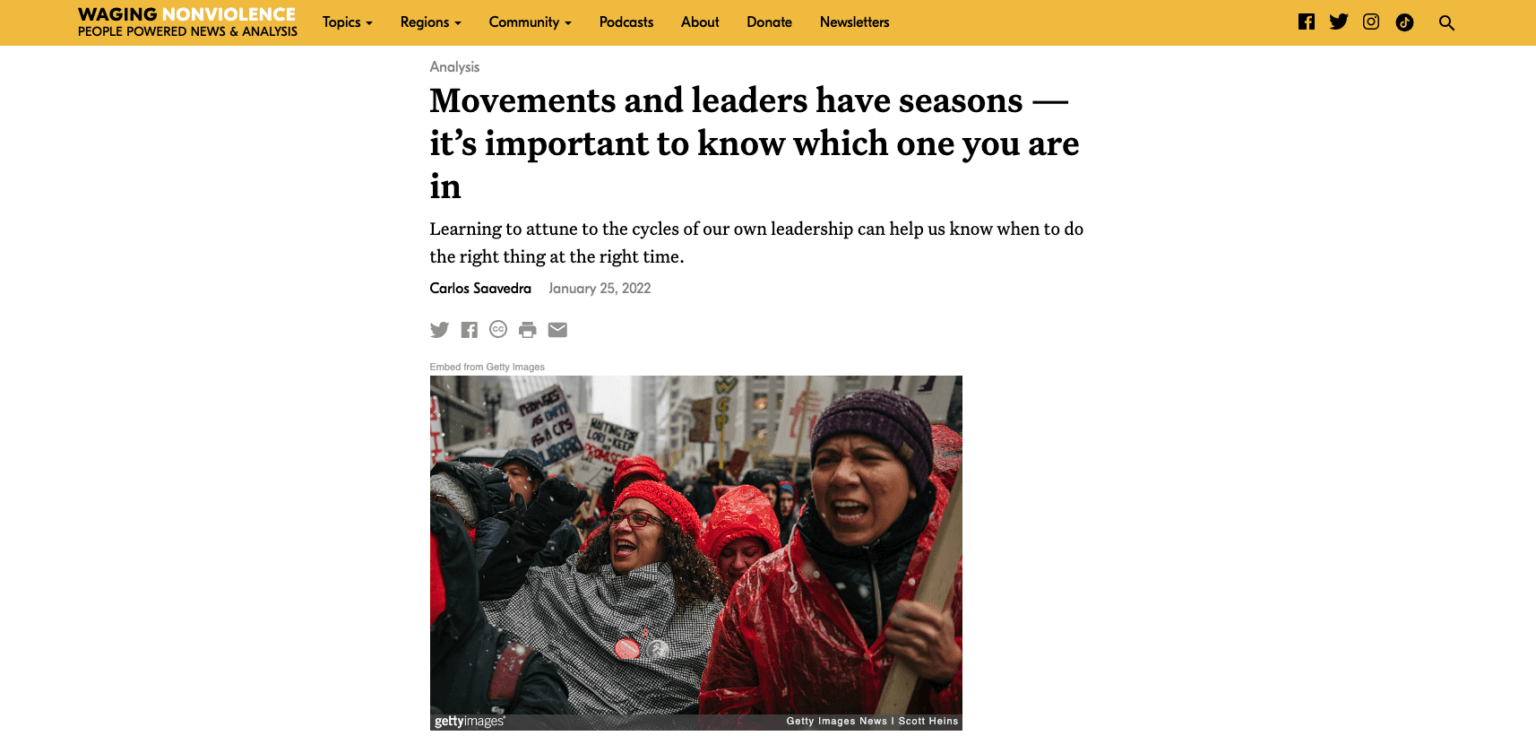

In 2019, Carlos Saavedra wrote an article for Waging Nonviolence on the importance of seasons for leaders and movements. Here’s an excerpt:
Over the last two years, social movements, organizations and leaders around the world have been thrust into a period of tumult, transition and uncertainty. These moments of crisis in our personal lives and in society can force sudden changes in our capacity to respond. What happens when we are not able to offer leadership like we used to? Or inversely, what happens when we do have the energy and capacity to respond, but our efforts don’t yield the results that are expected?
Responsibility is the essence of leadership, and millions of community leaders who are working hard to resolve difficult, structural problems are uncomfortable when they feel like they need to respond to the moment, but are unable to. This can lead to burnout, or worse: leaders leaving the movement altogether, creating vacuums of leadership that don’t honor the cycles of our own development….
Seasons of Leadership Workshops and Cohorts
Our organization conducts a range of live workshops and cohorts throughout the year, which are available both online and in person. To keep yourself updated about our latest events, you can visit our Event Calendar on the homepage that is linked here.
If you’re interested in attending our training on Seasons of Leadership or any other future training from Ayni, you can sign up to our Training Pool. By doing so, you take the first step in committing to attending the upcoming training(s) of your choice within the next six months once there’s enough people commited. You can explore our offerings and sign up to our trainings here.