Why This Training?
The challenges of the 21st century are generationally unprecedented. Most people alive today have never experienced crises of the magnitude we are now witnessing, including climate collapse, extreme wealth inequality, rising political instability, and rapid technological transformation across artificial intelligence, robotics, and nanotechnology. Traditional theories of change, social movement strategies, and organizing approaches are increasingly outdated. They were built for moments and conditions that no longer exist, while at the same time older traditions such as socialism, Indigenous worldviews, religious movements, and even fascism are re-emerging in response to systemic breakdowns.
We are in a time where political, economic, and historical education is necessary, not as an academic exercise, but as a fundamental tool for movement leaders who must navigate, strategize, and intervene effectively in this era of crisis.
At some point in every leader’s journey, a critical question arises: Are my efforts making a difference? If we are committing our lives to social transformation, our work must be judged by history. We must develop a deep, rigorous, and clear understanding of the major forces that have shaped societies in the past and those shaping the world today. This requires an education in religion, politics, economics, ideology, and institutions that is not typically accessible to most social movement practitioners.
This training is the culmination of a long search, what some call political education, advanced strategy, political formation, or worldview development. It is a fusion of historical analysis, systemic understanding, and practical application, aimed at crafting a strategy for change that is relevant to the 21st century.
A Decade in the Making
For over a decade, the Ayni Institute has been searching for the right frameworks to understand history and power beyond academic spaces and beyond single ideological formations. Our approach has been deeply influenced by the work of Kōjin Karatani and his groundbreaking Modes of Exchange framework, as well as by thinkers such as Immanuel Wallerstein through world-systems theory and Sherri Mitchell and Pablo Solon through Indigenous worldviews that challenge Eurocentric conceptions of social organization.
Since 2013, we have built a range of programs in an ongoing effort to answer a central question: How do we make deep political education accessible to movement leaders?
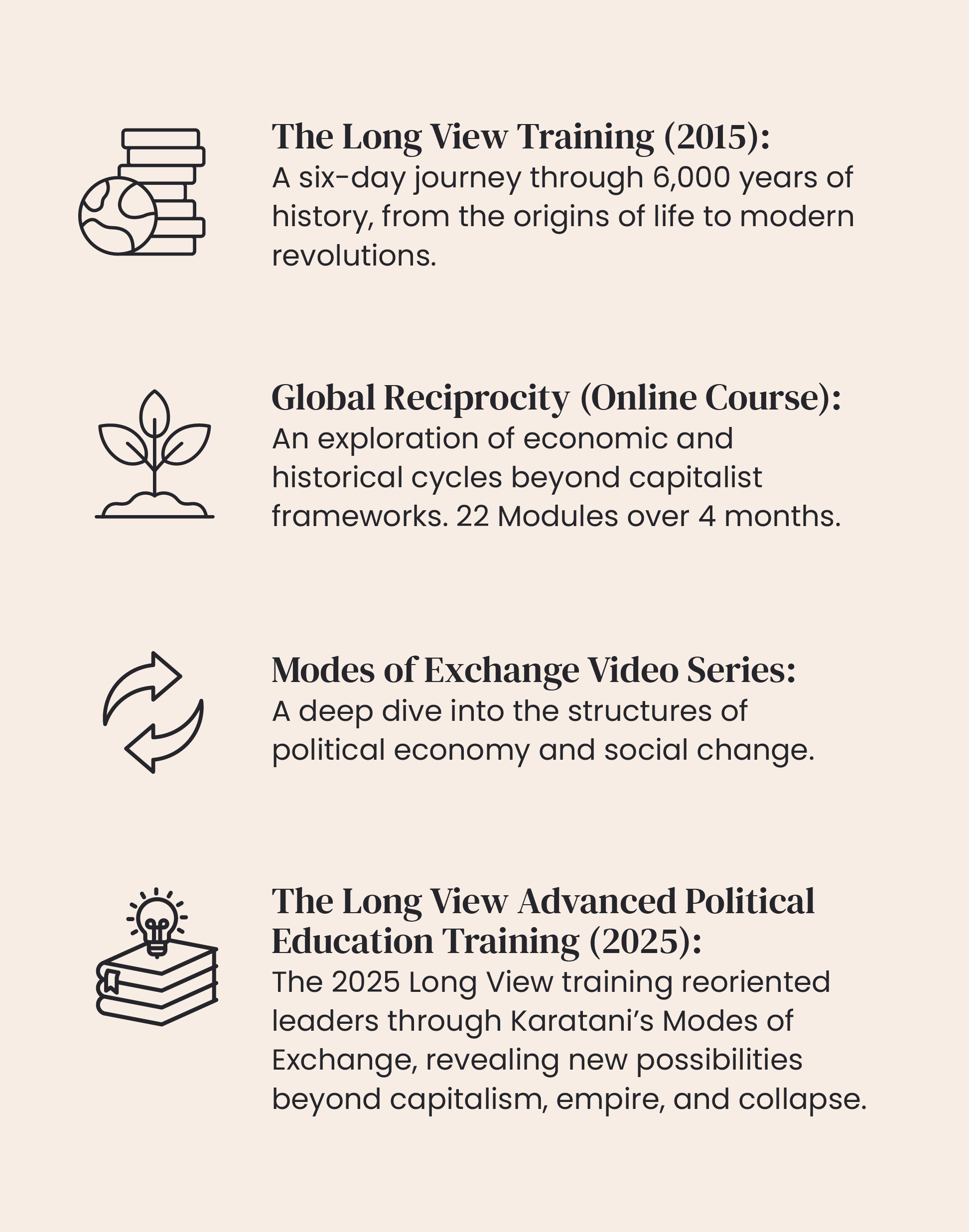
While Karatani’s Modes of Exchange framework serves as a powerful foundation, we recognize that no single framework is enough. We need multiple perspectives, from global political economy to spiritual traditions, in order to create a more complete theory of change.
While Karatani’s Modes of Exchange framework serves as a powerful foundation, we recognize that no single framework is enough. We need multiple perspectives, from global political economy to spiritual traditions, in order to create a more complete theory of change.
The Crisis in Political Education

One of the central challenges we face today is the deep divide between academic scholars and movement practitioners:
- Academics and intellectuals produce rigorous analysis but often lack direct engagement with movement work.
- Organizers and activists are deeply embedded in the struggle but lack access to the historical, economic, and philosophical training that could sharpen their strategies.
- Most people lack any form of advanced political education, as our education systems are either deeply fragmented or serve ideological functions that fail to equip leaders for real-world strategic interventions.
In Japan, where scholars like Kōjin Karatani and Kōzō Uno were formed, Marxist economic and political education was deeply integrated into university curricula, with students reading Capital Volumes I, II, and III as part of their basic training. The depth of education in political economy and historical materialism in certain parts of the world far exceeds what is available to activists and organizers in the West. We must raise our level of education if we want to intervene in history at the scale that this moment demands.
An Experiential Learning Approach
This is not an academic training. This is an experience, a journey through history that engages not just the intellect but also the body, the senses, and the spirit. Through lectures, exercises, music, ritual, and collective reflection, participants will develop an embodied historical understanding that transcends simple theoretical learning.
We believe that to think strategically, we must think historically. To act effectively, we must feel the weight of history in our bones.
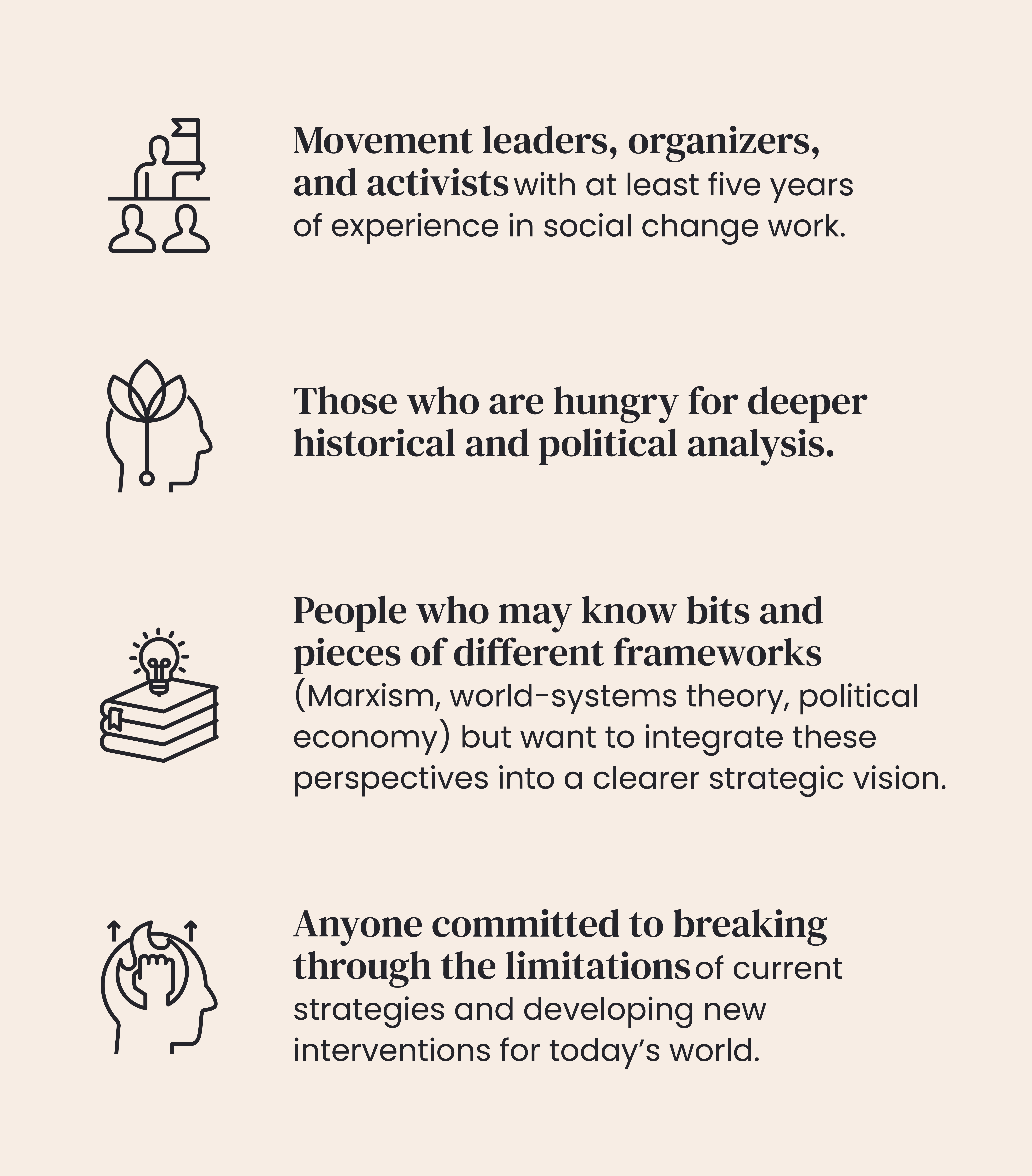
Who is This For?
The Commitment
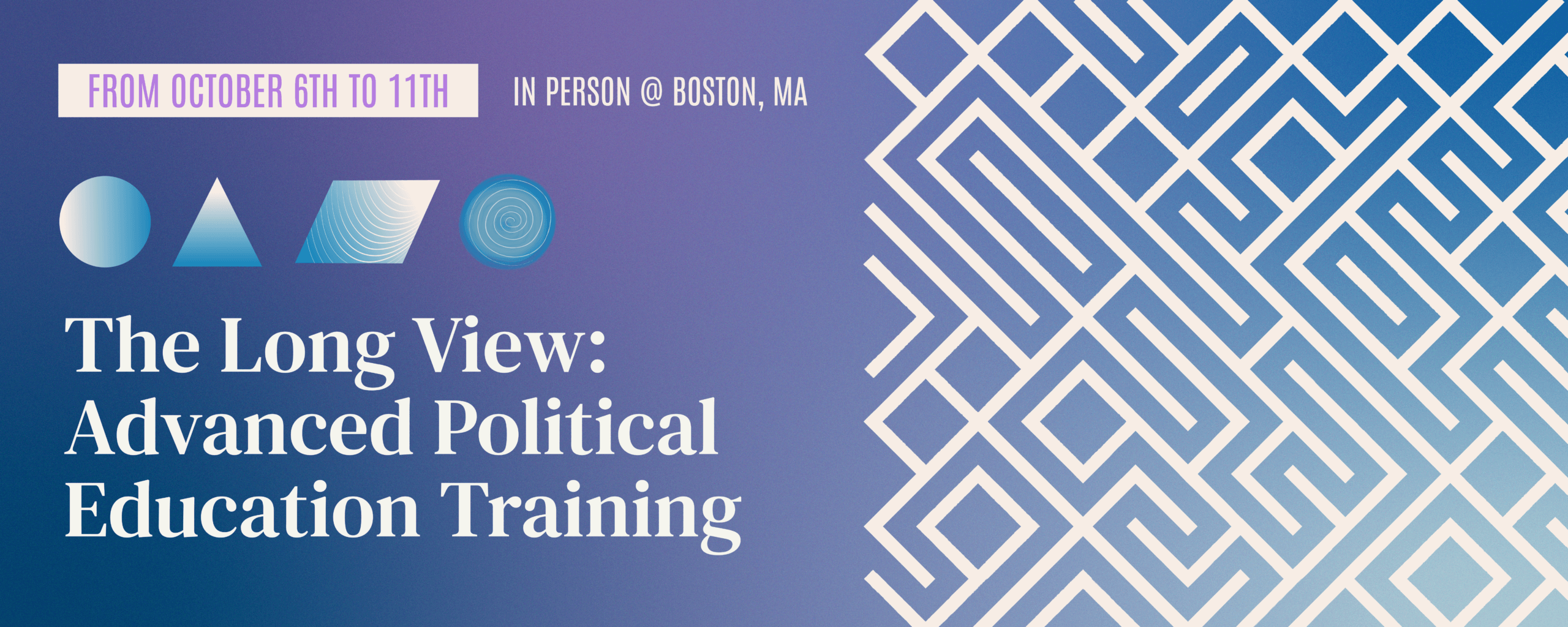
This is a six-day immersive experience at our Training Center in Boston, from October 6th – 11th. This is not a casual learning opportunity. It is a full commitment to deep study, reflection, and strategic development.
This training is offered as part of a gift economy. No one is paying tuition, but we rely on community support to sustain the space. Participants are invited to contribute in ways that reflect shared responsibility for the learning process.
Understanding the Gift Economy Model
We are excited to offer The Long View training through a gift economy model. What does that mean? A gift economy means that we are not charging tuition for anyone attending this training. Instead, the Ayni Institute is putting up the funds in advance to cover all essential costs, including food, training materials, space, and subsidized lodging for those in need.
In a gift economy, participants contribute what they can based on their means. If you can contribute more, you help sustain the training for others. If you cannot contribute financially, that is okay and your presence is valued. Unlike a traditional fee-based model where payment is a prerequisite for access, the gift economy is rooted in mutuality and reciprocity. It fosters a collective responsibility for making this training possible.
This approach reflects traditions found in other models, such as Dāna in Vipassana meditation, where past participants fund the next cohort. Similarly, Ayni in Andean communities embodies reciprocity, which is a core value of our organization. Our training also draws from Kōjin Karatani’s Modes of Exchange framework, which emphasizes the power of the pure gift and associationism. Through this training, we aim to cultivate a lived culture of Ayni, Dāna, and reciprocity.
How You Can Support This Training
- Come as you are. We’ll work with you to support your participation and help you get to the training when possible. That said, support depends on travel costs and other logistical factors.
- Engage your community. If possible, help us seek support from your networks.
- Contribute what you can. If you are in a position to give, your contribution helps sustain this and future trainings.
Financial Transparency: Training Costs
To provide transparency, we are sharing the actual cost breakdown:
- Total cost per participant: $1400 (includes lodging, food, and training materials, and labor for logistics)
- Most significant cost: Lodging
While there is no required payment, we offer suggested contributions for individuals and organizations:
Suggested Contributions
For Organizations:
- Tier 1: Annual budget under $150,000 → Suggested: $600
- Tier 2 (Solidarity): Annual budget $150,000–$500,000 → Suggested: $1000
- Tier 3 (Sustainer): Annual budget $500,000–$1M → Suggested: $1400
- Tier 4 (Institutional Sponsor): Annual budget over $1M → Suggested: $2000+
For Individuals:
Pay what you can. If you have financial resources, consider contributing more to support accessibility for all.
Volunteer and Institutional Support
All trainers and presenters are offering their time in the spirit of reciprocity. Additionally, the Ayni Institute is covering logistical and preparatory work, which is not factored into the above costs. If included, the total cost would be significantly higher. However, we believe in the power of community and collective support to sustain this work.
In the spirit of transparency, Ayni has not received any funding or grants for this training.
Thank you for being part of this journey and for engaging in a model that prioritizes access, reciprocity, and collective responsibility. We look forward to learning and building together!
Community Voices
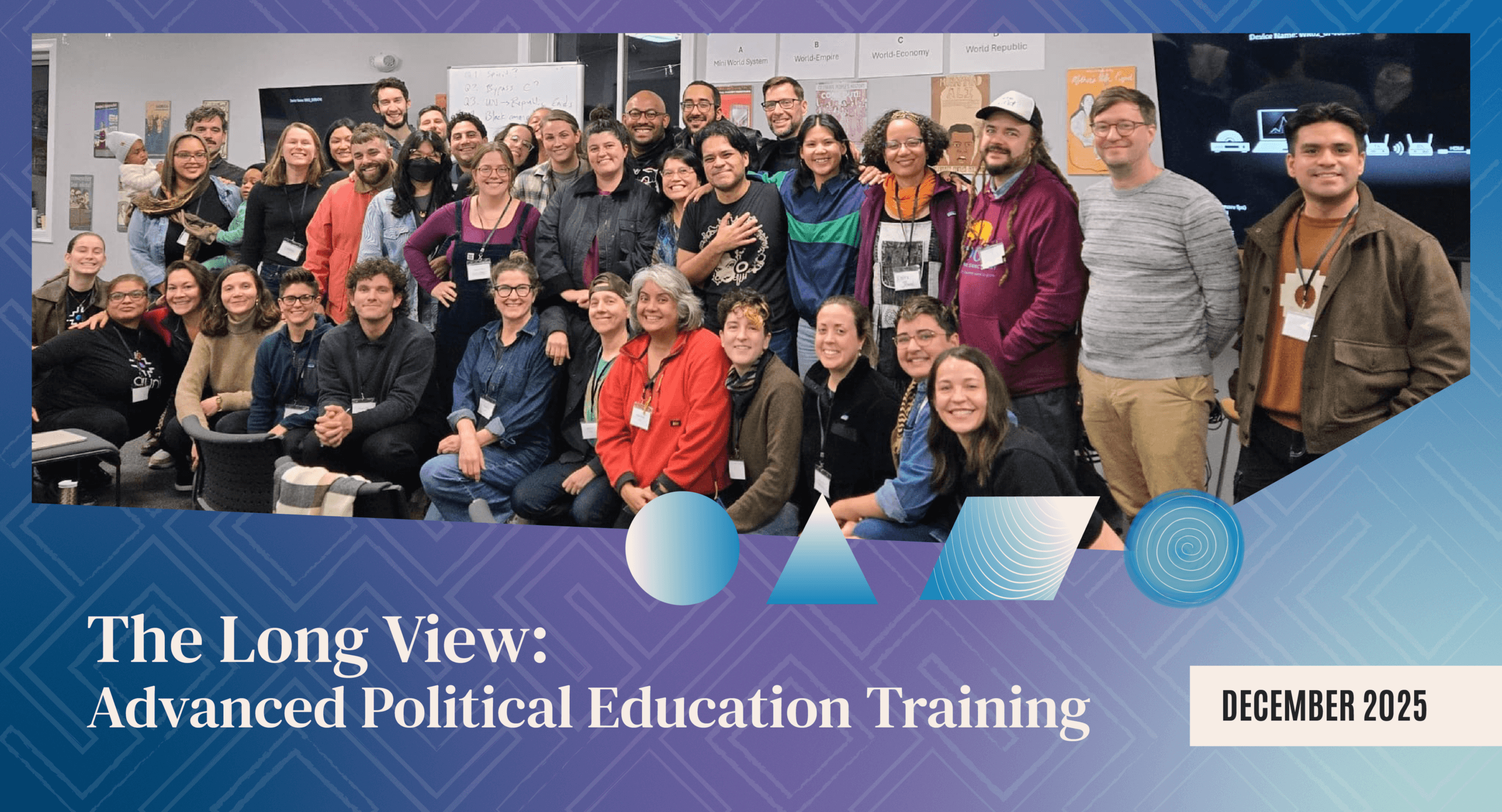
We are grateful to have hosted our first Long View training in over ten years this past December 2025. Bringing this work back after such a long pause felt meaningful and timely, and it was shaped deeply by the presence, care, and commitment of everyone who joined us.
We want to offer our sincere thanks to all the participants who showed up with curiosity, courage, and generosity. Your willingness to engage deeply with history, with one another, and with yourselves made this gathering what it was.
Below are a few reflections from participants, shared in their own words, about what the experience offered them and how it continues to shape their thinking and practice.