Education for Social Change Leaders
The Difficulties of Social Change Work
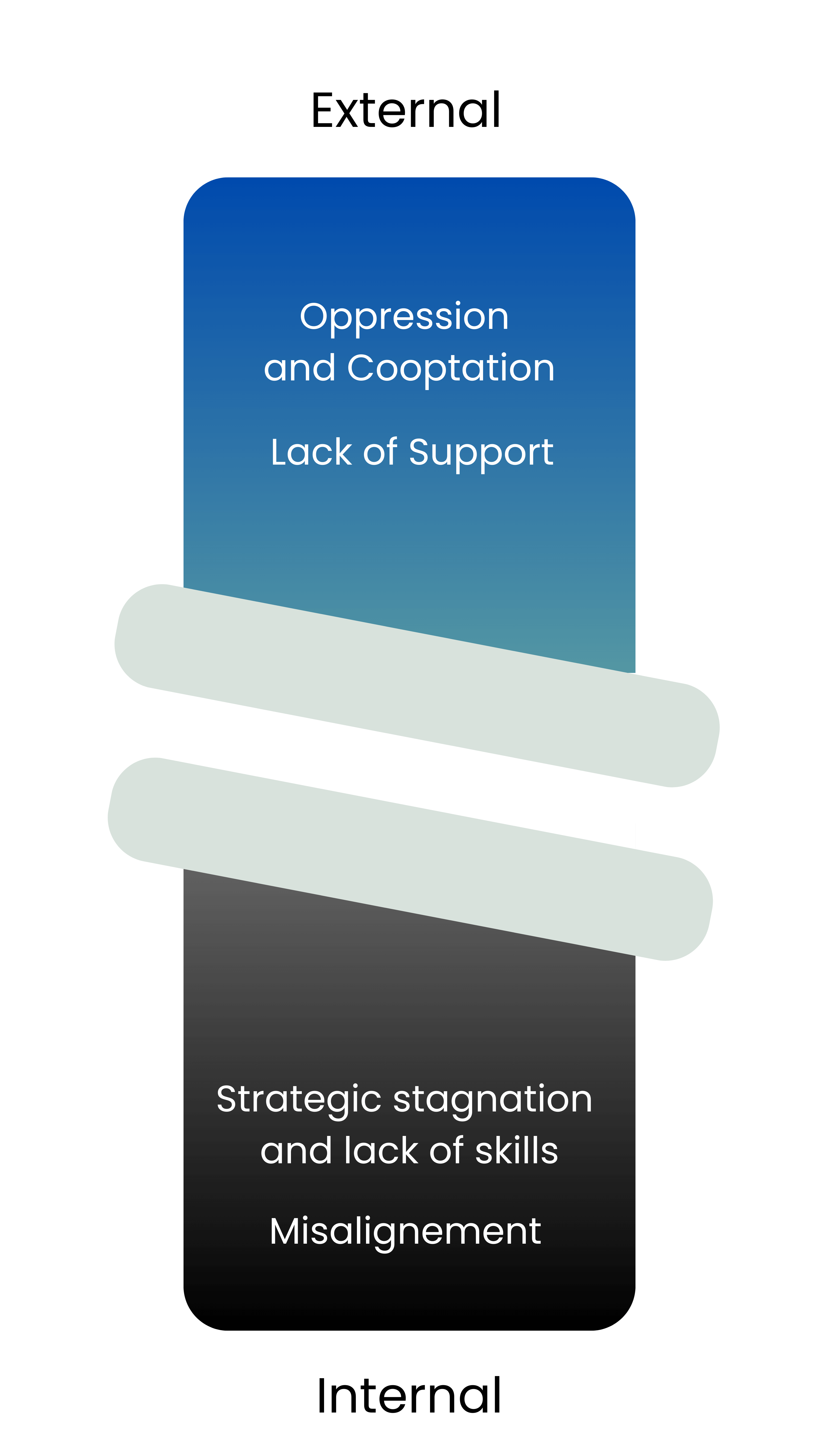
Engaging in social change efforts is undeniably challenging. Social movements contend with sophisticated and resilient historical, political, and economic structures that wield considerable resources and control over spaces of power. Moreover, our political and economic systems perpetuate oppression on a global scale, simultaneously marginalizing the majority while co-opting attempts from movements and groups striving to challenge the status quo. In this formidable landscape, social movements face an uphill battle.
Internal dynamics within social movements exacerbate these problems. Misalignment among organizational leaders threatens to tear movements apart with projects that are misaligned from broader strategic objectives and goals, resulting to futile work and energy expended.
Furthermore, at times movements and organizational leaders lack the skills, strategy, and expertise in social movement building. The harsh reality is that movements lack the support, the preparation, and the craft they need in order to truly challenge the bastions of power and bring forth the change that our world desperately needs. Compounding these issues is the stark reality that most movements are under-resourced and under-populated. Lack of access to infrastructure, funding, people, and time impedes their ability to realize their vision for change. This scarcity further limits their capacity to address pressing societal issues and bring about the change they want to see in the world.

The Areas of Study
New Ideology & Worldview
A grounded yet flexible ideological foundation, rooted in historical understanding, power analysis, practical social change methods, and spiritual traditions.
Leadership Maturity
Strengthening emotional resiliency, attuning to our personal cycles, and honoring the wisdom of our ancestors.
Organizational Development
The nuts and bolts skills and craft to strengthen the internal dynamics of our organizations.
Movement Building
The art of building social movements and ecosystems, fostering strategic capacity and popular support.
Start Your Movement Education
Self Paced Course Catalog
-
Ayni Institute
-
Ayni Institute
-
Ayni Institute
-
Ayni Institute
-
Ayni Institute
-
Ayni Institute
Power Up Your Organization
Resources
Movement Ecology
Ancestral Wisdom
- The Ayni Institute’s Memory Program helps preserve ancestral wisdom by supporting indigenous communities, sharing their knowledge with communities, and fostering cross-cultural learning through financial aid, community projects, and educational events. (Link)
- Mysteries of the Andes Film Series (Link)
- Zadir Milla’s Book Series in Spanish on The Secret Code of Machu Picchu and The Secret Code of Wira Qocha (Link)
- Seeds Course: The purpose of the Seeds Course is to support community members in developing and deepening their relationships to their community, to their ancestors, and to Mother Earth. (Link)
Funding Social Movements
- Guide: Funding Social Movements Guide: How Mass Protest Makes an Impact by Paul Engler, Sophie Lasoff, and Carlos Saavedra (Link)
Three Part Series on Stanford Social Innovation Review
- Article: Philanthropists Must Invest in Ecology of Change by Chloe Cockburn published on Stanford Social Innovation Review (Link)
- Article: Protests Movements Need the Funding They Deserve by Paul Engler published on Stanford Social Innovation Review (Link)
- Article: Five Ways Funders Can Support Social Movements by Carlos Saavedra published on Stanford Social Innovation Review (Link)
Seasons
Modes of Exchange
Self-Paced Courses
Mass Protest
- Webinar: Momentum Webinar Video Series -Recorded in the early days of Ayni 2014 (Link)
- Video Series: Swarm Training on Decentralized Organization Video Series (Link)
- Book: This is an Uprising: How Nonviolent Revolt is Shaping the 21st Century by Paul Engler and Mark Engler (Link)
- Book: The Resistance Guide: How to Sustain the Movement to Win by Paul Engler and Sophie Lasoff (Link)
- Film Series: A Force more Powerful by the International Center of Nonviolent Conflict (Link)
- Book: 198 Methods of Nonviolent Action by Gene Sharp (Link)