Welcome
We’re thrilled to invite you to our newest training: Organizational & Project Design Lab
A six-week immersive online training (with two full Saturdays) designed to help practitioners in social change understand, build, and grow organizations that both innovate and scale.
Why This Training Now
At the Ayni Institute, we’ve spent years supporting organizations and leaders across the social change field, from community organizers and cooperatives to mass movements and service programs. In every context, we’ve seen the same truth: great ideas alone aren’t enough.
What often holds back powerful visions is not the passion or the cause, but the organization itself. Most of us enter this work focused on issues, goals, and campaigns. Over time, we come to see that our ability to create lasting impact depends just as much on how we build, lead, and evolve our organizations.
Yet when we turn to the field of “organizational development,” the frameworks available often emerge from business management or bureaucratic traditions. These approaches don’t always align with the mission, culture, or lived realities of movements for justice and transformation. At the same time, we recognize that many of these frameworks reflect genuine and universal patterns of growth, coordination, and learning. The challenge and the opportunity lie in adapting and translating them to the realities of social change.
We believe movements deserve their own language of design, one that honors both the universal dynamics of how groups evolve and the unique challenges of fighting for justice and transformation. As Henry Mintzberg reminds us, an organization is “a collective action structure for the pursuit of a common mission.” Yet the question remains: how do we balance the need to strengthen what already works while continuing to invent what’s next? How do we serve our purpose by being both efficient and creative, both disciplined and visionary?
The Organizational & Project Design Lab was born from that question. It focuses on two fundamental processes that shape every organization:
Scaling what works. Many of us already run programs, campaigns, or practices that are effective but limited in reach. How do we take something that serves hundreds and grow it to reach thousands without losing its spirit?
Inventing what’s missing. At the same time, there are countless domains in our work where no good models exist yet. We need creativity, experimentation, and courage to build the next generation of solutions while also holding realistic expectations about what’s still in the experimental stage. These two processes, innovation and maximization, are deeply complementary but fundamentally different. Each requires its own mindset, structure, and rhythm.
This training offers a framework and a process to help you do both: to balance invention and replication, creativity and discipline, innovation and scale. We see this as a crucial capacity for our times. Across movements, new forms of organizing, healing, and cooperation are emerging. Too often, they are without shared theory or tools. Our hope is that this course gives you a common toolbox to think more clearly, design more intentionally, and accelerate what’s possible.
If we can innovate faster, not in decades but within a few years, and scale what works without losing what’s essential, we can transform how social change unfolds. That’s the invitation of the Organizational & Project Design Lab: to scale what works and design what’s missing.
What You’ll Gain
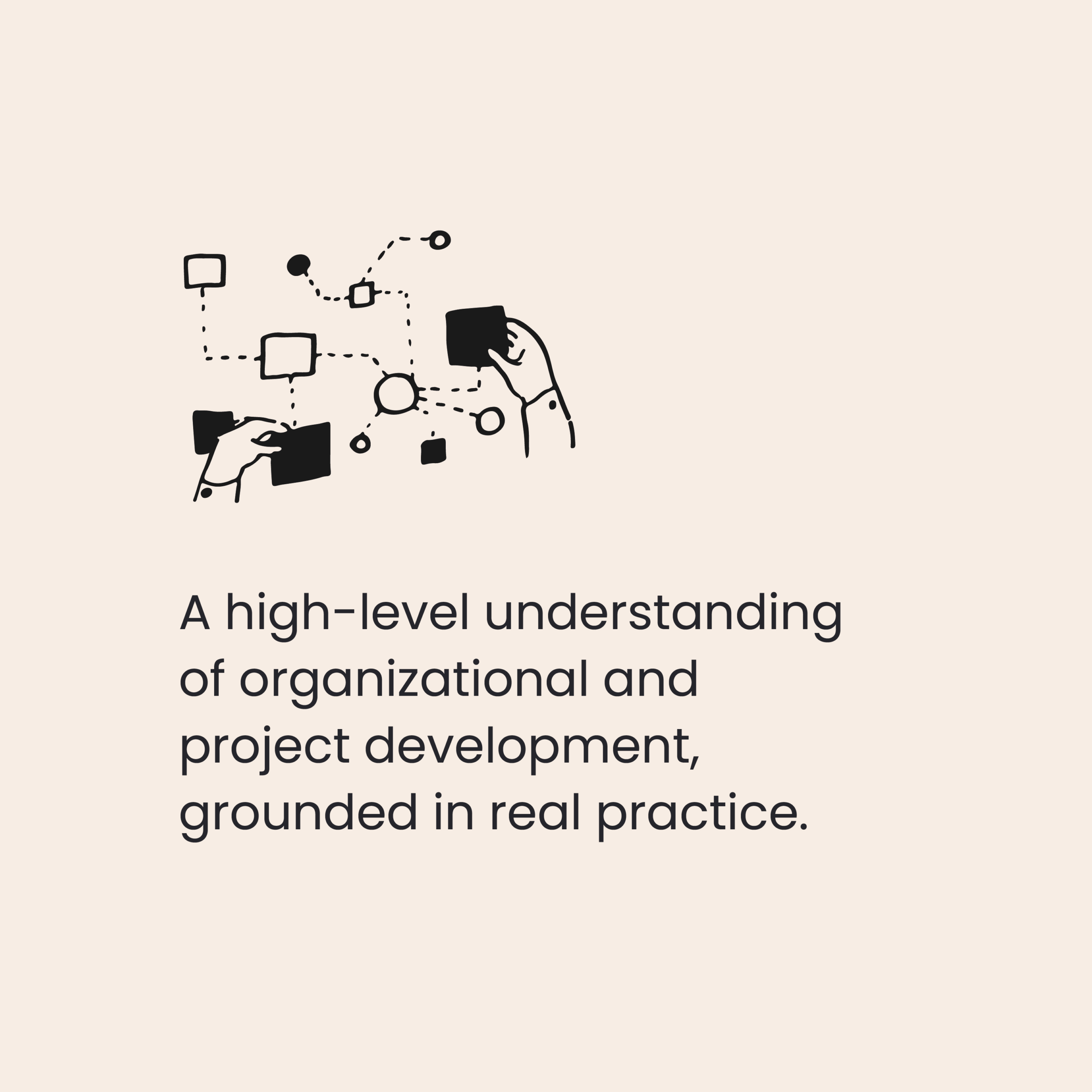
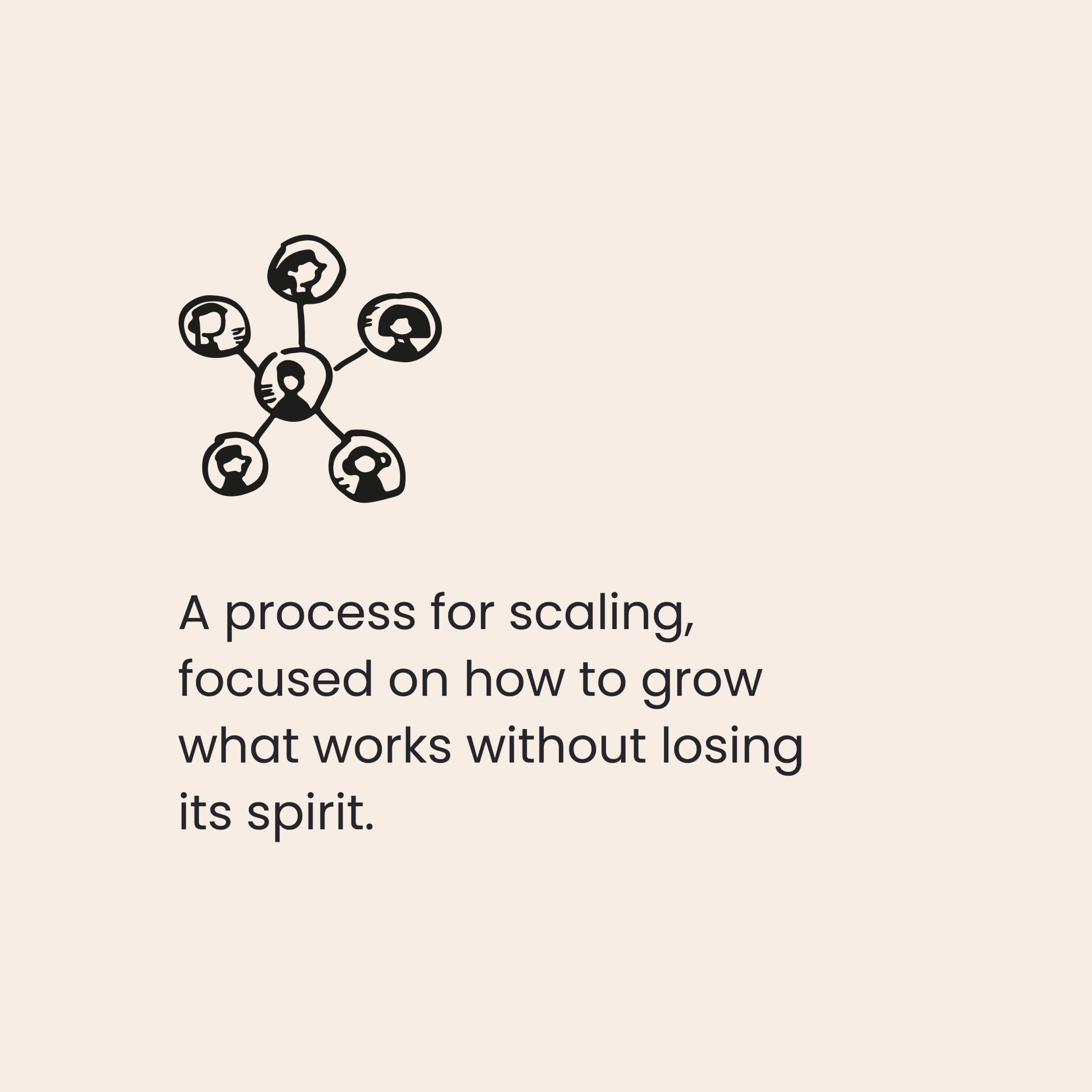
Whether you lead a community organization, run a protest movement, or coordinate healing work, this framework will help you see your work through a new lens of development and design.
Who It's For
- Want to make your organization more effective, coherent, or scalable.
- Feel the social change field needs new solutions, and you want a process to create them.
- Already have something that works and need to learn how to scale without breaking it.
Why This Training Now
At the Ayni Institute, we’ve spent years supporting organizations and leaders across the social change field, from community organizers and cooperatives to mass movements and service programs. In every context, we’ve seen the same truth: great ideas alone aren’t enough.
What often holds back powerful visions is not the passion or the cause, but the organization itself. Most of us enter this work focused on issues, goals, and campaigns. Over time, we come to see that our ability to create lasting impact depends just as much on how we build, lead, and evolve our organizations.
Yet when we turn to the field of “organizational development,” the frameworks available often emerge from business management or bureaucratic traditions. These approaches don’t always align with the mission, culture, or lived realities of movements for justice and transformation. At the same time, we recognize that many of these frameworks reflect genuine and universal patterns of growth, coordination, and learning. The challenge and the opportunity lie in adapting and translating them to the realities of social change.
We believe movements deserve their own language of design, one that honors both the universal dynamics of how groups evolve and the unique challenges of fighting for justice and transformation. As Henry Mintzberg reminds us, an organization is “a collective action structure for the pursuit of a common mission.” Yet the question remains: how do we balance the need to strengthen what already works while continuing to invent what’s next? How do we serve our purpose by being both efficient and creative, both disciplined and visionary?
The Organizational & Project Design Lab was born from that question. It focuses on two fundamental processes that shape every organization:
Scaling what works. Many of us already run programs, campaigns, or practices that are effective but limited in reach. How do we take something that serves hundreds and grow it to reach thousands without losing its spirit?
Inventing what’s missing. At the same time, there are countless domains in our work where no good models exist yet. We need creativity, experimentation, and courage to build the next generation of solutions while also holding realistic expectations about what’s still in the experimental stage. These two processes, innovation and maximization, are deeply complementary but fundamentally different. Each requires its own mindset, structure, and rhythm.
This training offers a framework and a process to help you do both: to balance invention and replication, creativity and discipline, innovation and scale. We see this as a crucial capacity for our times. Across movements, new forms of organizing, healing, and cooperation are emerging. Too often, they are without shared theory or tools. Our hope is that this course gives you a common toolbox to think more clearly, design more intentionally, and accelerate what’s possible.
If we can innovate faster, not in decades but within a few years, and scale what works without losing what’s essential, we can transform how social change unfolds. That’s the invitation of the Organizational & Project Design Lab: to scale what works and design what’s missing.
What You’ll Gain
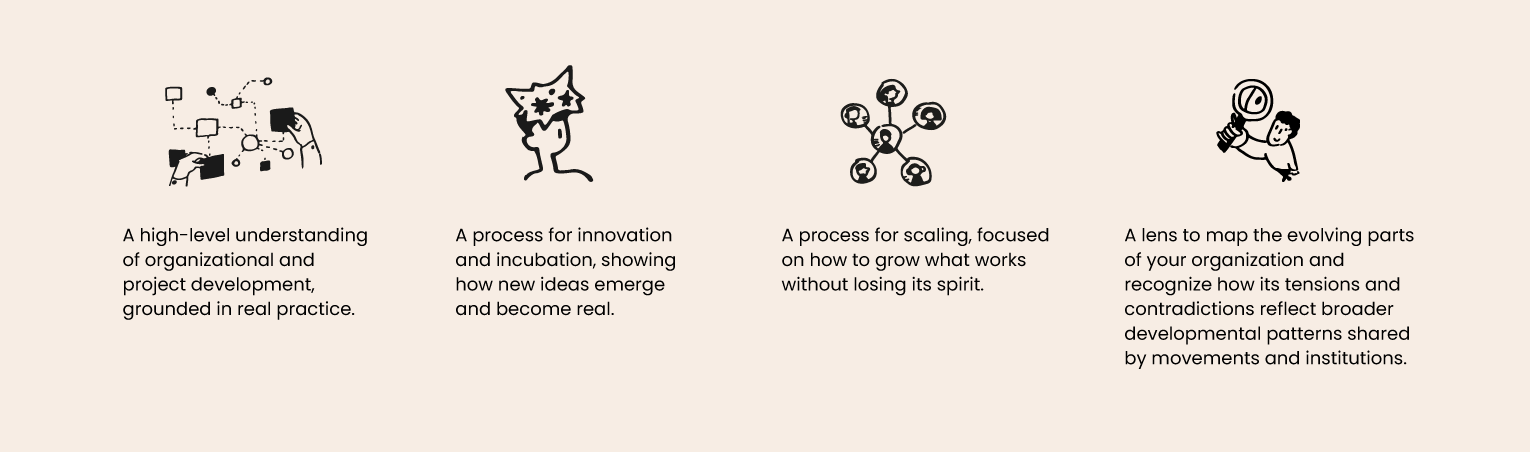
Whether you lead a community organization, run a protest movement, or coordinate healing work, this framework will help you see your work through a new lens of development and design.
Who It's For
- Want to make your organization more effective, coherent, or scalable.
- Feel the social change field needs new solutions, and you want a process to create them.
- Already have something that works and need to learn how to scale without breaking it.
Format & Schedule
Duration: 6–7 weeks
Schedule: Two full Saturdays (opening and closing sessions) + weekly 3-hour sessions on Wednesdays
Time:
Wednesday sessions: 1 PM EST
Saturday: 9 AM to 6 PM EST (with a 2-hr break)
Format: Interactive group training held online
Session 1: The Two Worlds of Organizational & Project Development on March 7th (Daylong Session)
Explore the two essential modes of growth: innovation and maximization (scale). Learn how each requires different ways of thinking, deciding, and leading. In this session, you’ll map your organization through both lenses, begin developing a heat map of where each area sits on the spectrum, and understand the crucial difference between working in your organization and working on it.
Session 2: The Creative Process on March 11th (Wednesday Session)
Where does innovation come from? In this session, we’ll draw lessons from culture, music, film, and social movements to uncover how creativity truly emerges. Together, we’ll explore the major processes of innovation from inspiration to iteration. We will examine how new ideas take shape and move through the world in general and in the sector of social change.
Session 3: The Replication & Diffusion Process on March 18th (Wednesday Session)
To understand scale in social change, we must see organizations not just as machines but also as living organisms. In this session, we’ll explore concepts such as Organizational and Movement DNA and processes like frontloading, incubation, inoculation, and replication. We’ll examine how ideas, practices, and structures spread, and we’ll uncover the unique opportunities and modes of scaling that distinguish social change organizations from traditional business models. Starting in Session 4, we will work with specific processes for both incubating new initiatives and scaling what already works.
Session 4: Working with the Unknown on March 25th (Wednesday Session)
Every organization faces moments when the path forward isn’t clear. In this session, we’ll explore how to stay creative and grounded amid uncertainty. We’ll discuss how to notice emerging patterns, ask better questions, and cultivate the conditions for new insight to appear. You’ll learn how to engage in clear exploration: scouting what’s working, testing possibilities, and choosing directions that make sense. Inspired by Ellen Langer’s work on mindfulness, we’ll begin to notice how our usual ways of framing problems and solutions can trap us in fixed categories. Together, we’ll do exercises to loosen those habits and open space for more creative thinking.
Session 5: Turning Insight into Practice on April 1st (Wednesday Session)
Once new ideas appear, how do they become shared ways of working? In this session, we’ll explore how to translate inspiration into clear methods your whole team can use. How do we turn intuition and experimentation into practices that others can follow, refine, and build upon? We’ll also examine the apprenticeship model as a pathway for transmitting craft, exploring its unique strengths and limitations, and how it shapes cultures of learning within organizations.
Session 6: Building Systems that Scale on April 11th (1st Part of Daylong Session)
When something works, the challenge becomes how to grow it without losing its essence, especially when it must be shared with others or adapted to new contexts. Scaling introduces a new set of questions: how do we preserve what makes our work alive while allowing it to spread?
In this session we’ll explore practices of frontloading and inoculating organizational DNA, designing systems and structures that embed your core values and methods from the start. We’ll also look at the processes of systematizing, automating, and optimizing the elements of your work so they can scale, evolve, and improve over time. You’ll learn how to build organizational forms that sustain growth while staying true to your purpose.
Session 7: Personal Tools and Stance for the Journey on April 11th (2nd Part of Daylong Session)
In this closing session, we’ll explore how to become the kind of leader who can bridge the two essential forces within any organization, innovation and maximization (scale), and help them move in healthy rhythm rather than tension. We’ll focus on developing your personal tools, mindsets, and approaches so you can carry this way of thinking and working throughout your own personal vocation. Finally, we’ll look at the initial steps and practices needed to begin embedding this orientation into your current organization.
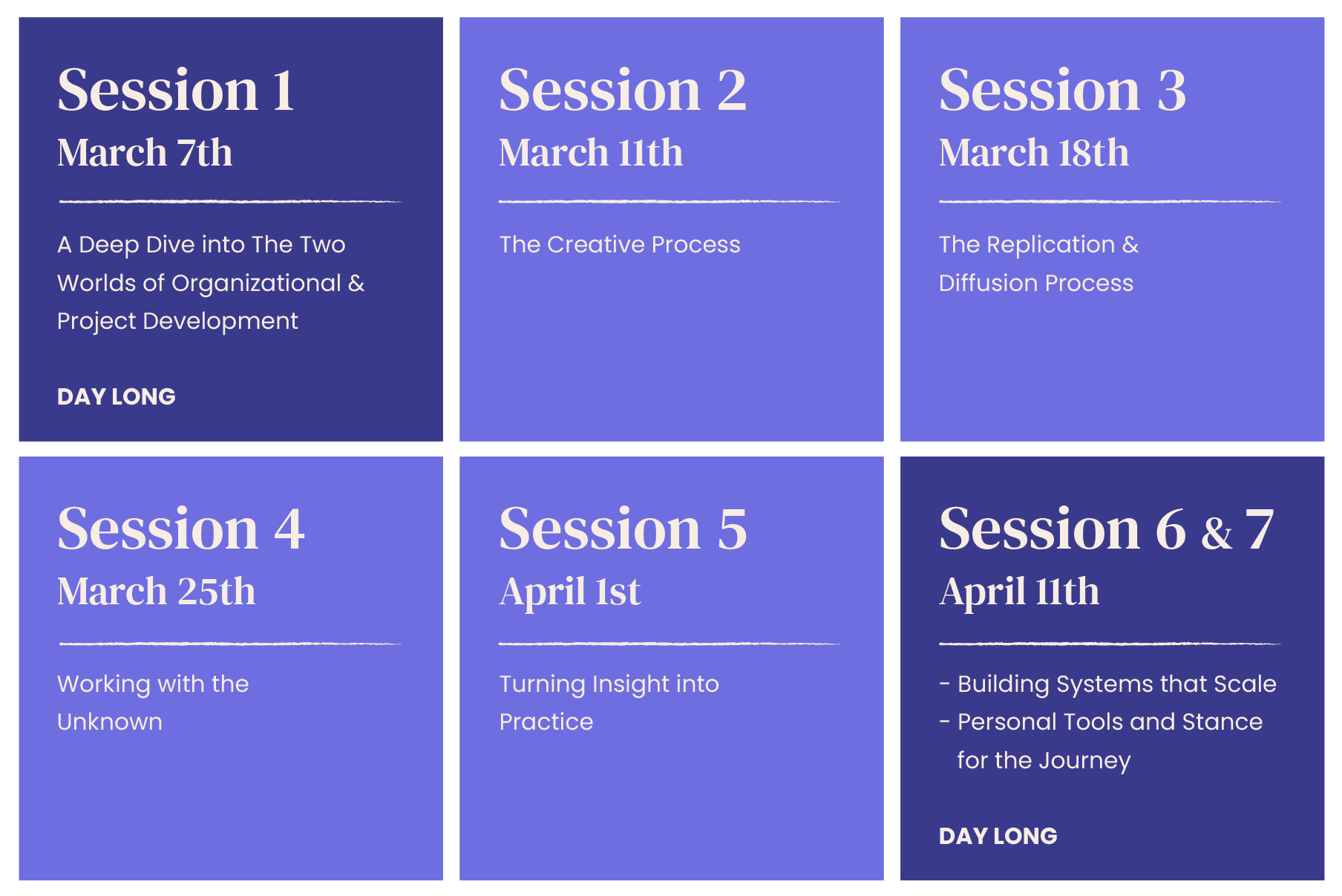
The training on March 7th will be a full-day session to kick things off.
Session 1: The Two Worlds of Organizational & Project Development
Explore the two essential modes of growth: innovation and maximization (scale). Learn how each requires different ways of thinking, deciding, and leading. In this session, you’ll map your organization through both lenses, begin developing a heat map of where each area sits on the spectrum, and understand the crucial difference between working in your organization and working on it.
Session 2: The Creative Process
Where does innovation come from? In this session, we’ll draw lessons from culture, music, film, and social movements to uncover how creativity truly emerges. Together, we’ll explore the major processes of innovation from inspiration to iteration. We will examine how new ideas take shape and move through the world in general and in the sector of social change.
Session 3: The Replication & Diffusion Process
To understand scale in social change, we must see organizations not just as machines but also as living organisms. In this session, we’ll explore concepts such as Organizational and Movement DNA and processes like frontloading, incubation, inoculation, and replication. We’ll examine how ideas, practices, and structures spread, and we’ll uncover the unique opportunities and modes of scaling that distinguish social change organizations from traditional business models. Starting in Session 4, we will work with specific processes for both incubating new initiatives and scaling what already works.
Session 4: Working with the Unknown
Every organization faces moments when the path forward isn’t clear. In this session, we’ll explore how to stay creative and grounded amid uncertainty. We’ll discuss how to notice emerging patterns, ask better questions, and cultivate the conditions for new insight to appear. You’ll learn how to engage in clear exploration: scouting what’s working, testing possibilities, and choosing directions that make sense. Inspired by Ellen Langer’s work on mindfulness, we’ll begin to notice how our usual ways of framing problems and solutions can trap us in fixed categories. Together, we’ll do exercises to loosen those habits and open space for more creative thinking.
Session 5: Turning Insight into Practice
Once new ideas appear, how do they become shared ways of working? In this session, we’ll explore how to translate inspiration into clear methods your whole team can use. How do we turn intuition and experimentation into practices that others can follow, refine, and build upon? We’ll also examine the apprenticeship model as a pathway for transmitting craft, exploring its unique strengths and limitations, and how it shapes cultures of learning within organizations.
The training on April 11th will be a full-day session to close things off.
Session 6: Building Systems that Scale
When something works, the challenge becomes how to grow it without losing its essence, especially when it must be shared with others or adapted to new contexts. Scaling introduces a new set of questions: how do we preserve what makes our work alive while allowing it to spread?
In this session we’ll explore practices of frontloading and inoculating organizational DNA, designing systems and structures that embed your core values and methods from the start. We’ll also look at the processes of systematizing, automating, and optimizing the elements of your work so they can scale, evolve, and improve over time. You’ll learn how to build organizational forms that sustain growth while staying true to your purpose.
Session 7: Personal Tools and Stance for the Journey
In this closing session, we’ll explore how to become the kind of leader who can bridge the two essential forces within any organization, innovation and maximization (scale), and help them move in healthy rhythm rather than tension. We’ll focus on developing your personal tools, mindsets, and approaches so you can carry this way of thinking and working throughout your own personal vocation. Finally, we’ll look at the initial steps and practices needed to begin embedding this orientation into your current organization.
The Practical Stuff
Training Cost Pricing Guide
Training Fee Structure
At our organization, we believe that financial barriers should not prevent anyone from accessing our trainings. To ensure accessibility, we use a tiered cost model, where fees are adjusted based on individual income or organizational budget. Higher tiers help subsidize lower tiers, making the training available to a broader community.
There Are Two Payment Options:
1) Individual Payment:
If you are paying out of pocket, you will be charged the individual rate based on your selected tier. For example, if you qualify for the Reciprocity tier, your tuition is $150, and that is the total amount you pay.
2) Organizational Payment:
If your participation is funded by an organization, your fee depends on your organization’s budget tier.
For example, if your organization qualifies for the Sustainer tier, the cost is:
- $500 for one participant
- $1,500-2,000 for a group of three to four participants
For more details on where you or your organization fit within these tiers, please refer to the chart below and the two Tiers In-Detail Sections.
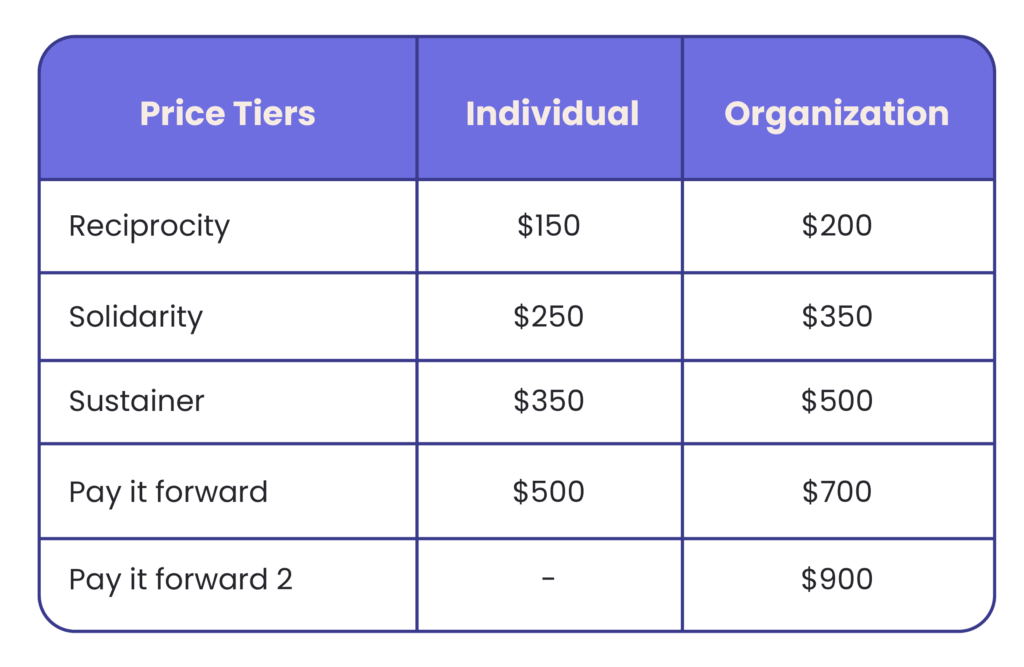
Organization Pricing Tiers In-Detail
If you are an emerging, nascent organization within your first 3 years, or under resourced with a budget under $150K, your organization falls under this tier.
You are a small to midsize organization with a budget ranging from $150 – $600 K.
Your are an established organization with a budget within the range of $600 – $1.5 million annually.
You are a stable organization with a budget of $1.5million+.
You are a stable organization with a budget of $5million+.
Individual Pricing Tiers In-Detail
Essentially, you have a hard time meeting your basic needs, you work in social change, or are not affiliated with an organization that can sponsor your enrollment.
Stability on Meeting Basic Needs
- I am unemployed or underemployed
- I frequently stress about meeting basic needs & don’t always achieve them
- I rent lower-end properties or have unstable housing
- I don’t have transportation and/or have limited access to a car
- I cannot afford a vacation or have the ability to take time off without financial burden
Wealth & Debt
- I have debt and it mostly prohibits me from meeting my basic needs
- I have no access to savings
- I qualify for government assistance including food stamps & health care
- I have no or very limited expendable income
- I rarely buy new items because I am unable to afford them
- I do not have or expect to inherit money or property
Education & Immigration Status
- I may not have completed high school or GED, or have limited experience with higher education
- I do not have U.S. Citizenship & do not qualify for any government assistance
You can meet some of your basic needs but don’t have long-term security. If you identify with all or the majority of the indicators please select this tier.
Stability on Meeting Basic Needs
- I rent lower-end properties but have stable housing
- I have access to transportation or have access to a car
- I am employed, underemployed, living paycheck to paycheck
- I have limited amounts of expendable income
- I don’t often buy new items (but I can if needed) and I thrift other items
- I have very limited funds for a vacation
Wealth & Debt
- I have debt which could prohibit me from meeting my basic needs, but I am currently able to make monthly payments
- I might have access to government assistance or subsidies
- I might have a little savings saved up
- I do not have a safety net composed of “financially stable” or wealthy family and friends
Education & Immigration Status
- I might have attended a community college or public higher education institution
- I have not attended private education institutions or have an advanced degree
- I have work permit, TPS or employee sponsorship providing me some income to meet my basic needs
This is for individuals who are able to meet their basic needs and have the support for long term financial stability and ability to pay the actual cost without being financially burdened.
Stability on Meeting Basic Needs
- I own or lease a used or lower end car & have access to transportation
- I am employed/have stable income
- I have access to health care (private or public) & don’t rely on government benefits
- I can take a vacation annually or every few years without financial burden
- I qualify for first time home buyers programs or subsidies to purchase a house or property
Wealth and Debt
- I might have debt but don’t usually stress about meeting my basic needs and regularly achieve them
- I have access to financial savings
- I have expendable income
- I am able to buy mostly new items
- I am expecting to inherit small amounts of money or property
Education and Immigration Status
- I have U.S. Citizenship or other citizenship that allows me freedom of mobility
- I might have private education institutions or have an advanced degree
This tier is for higher-earning individuals that can meet all of their basic needs, have support for long term financial stability, has built wealth with the ability to share their abundances.
Stability on Meeting Basic Needs
- I am comfortably able to meet all of my needs & desires
- I own my home or property OR I rent a higher-end property
- I own or lease a higher end or multiple car(s)
- I have regular access to health care
I am employed or do not need to work to meet my needs - I have a safety net composed of “financially stable” or wealthy family and friends
Wealth and Debt
- I have access to financial savings & access to wealth
- I have an expendable income
- I can always buy new items
- I can afford an annual vacation or take time off when needed
- I own property or multiple properties
- I have and/or expect to inherit significant money or property
Education and Immigration Status
- I have attended a private education institution or have an advanced degree
- I have U.S. Citizenship or other citizenship that allows for mobility around the world
After reviewing the tier qualifiers, please select the one you self-identify with and the price rate that applies to your tier. Things to consider when reviewing the following tiers:
The following is our guide to help you think about what rate you qualify for and doesn’t encompass all of your personal factors.
Please make sure to consider any personal financial responsibilities; work, family, health, etc. when selecting your tier.You do not have to meet all the factors to fall into a category. Instead, these should be guideposts to help you think about what tier you qualify for. If most of the qualifiers describe you or your situation, you are in that tier.
Reimbursement Policy
For In-Person and Online Trainings
Future Training Interest Form
We welcome social change practitioners who want to deepen their organizational development skills and are ready to reflect, experiment, and fully engage in the learning process.
The March–April 2026 training application deadline has passed. Sign up to receive updates about future Organizational & Project Design Lab cohorts.