

Thank You for Building with Us
Thank you to everyone who joined us for the 3-day Seasons of Leadership Retreat. It meant a lot to be in a space with so many thoughtful, committed leaders—learning together, asking hard questions, and reflecting on what this moment is asking of us.
We’re planning to host another Seasons of Leadership Retreat in 2026. If you’d like to stay in the loop, you can sign up for updates using the form below.
Hope to keep building with you.
The Ayni Team
The Seasons framework is an approach that draws inspiration from spiritual and indigenous traditions, which the Ayni Institute has adopted to help us understand the cyclical patterns of our leadership, organizational growth, and broader societal shifts. This framework uses the metaphor of seasons—winter, spring, summer, and fall—to represent the four distinct stages of leadership cycles.
Every stage of this cyclical process serves a distinct purpose, and offers unique gifts and limitations that are instrumental in shaping our approach to leadership, organizational development, and movement strategies.
- Winter symbolizes rest, reflection, and the challenges of uncertainty or scarcity. It is a time for introspection, recommitting, and preparing for renewal.
- Spring is the season of planting seeds, initiating projects, and embracing new possibilities. It is marked by experimenting, risk-taking, and curiosity.
- Summer represents growth, productivity, and the hard work of nurturing what has been started. It is often a time of intensity and focus.
- Fall is the season of harvesting results, celebrating accomplishments, and anticipating the winter ahead.
By recognizing and embracing these cycles, we can align our actions with the current season, supporting our effectiveness and well-being.
During the Seasons of Leadership Retreat we will be diving deeper into the frameworks by both mapping the ebbs and flows within our leadership journeys, and dealing with what it means when your organization is in a season that feels difficult to sustain. We will take time to emotionally process the season we are in, and learn strategies and techniques to deal with the anxiety, stress, frustration, and rollercoaster of emotions that we face while doing social change work. In particular, we will gain a new perspective on leadership Winters and learn techniques for how to go through them. We will take the time to slow down and reflect, to commune with each other and nature, and to be better prepared for the season we are in and our future leadership cycles.
For those who have attended previous workshops on the Seasons Framework, this retreat introduces new content and a deeper level of engagement with the material. For newcomers, it offers an accessible and supportive introduction to the concepts.
Key Takeaways
- Gain Clarity on Leadership Seasons: Understand the purpose, unique gifts, and challenges of each season in your leadership cycle.
- Identify and Align with Your Current Season: Recognize the season you are in, map your leadership cycles, and learn how to meet your personal needs while complementing your organization or movement’s season.
- Process the Season You are in: Learn strategies alongside others to deal with the rollercoaster of emotions that we face in the journey of social change.
- Develop Winter Techniques: Learn practical approaches for navigating leadership Winters.
- Connect with others: Have a different level of conversation with others in social change who are applying the frameworks of seasons and cycles into their lives.
The Seasons framework is an approach that draws inspiration from spiritual and indigenous traditions, which the Ayni Institute has adopted to help us understand the cyclical patterns of our leadership, organizational growth, and broader societal shifts. This framework uses the metaphor of seasons—winter, spring, summer, and fall—to represent the four distinct stages of leadership cycles.
Every stage of this cyclical process serves a distinct purpose, and offers unique gifts and limitations that are instrumental in shaping our approach to leadership, organizational development, and movement strategies.
- Winter symbolizes rest, reflection, and the challenges of uncertainty or scarcity. It is a time for introspection, recommitting, and preparing for renewal.
- Spring is the season of planting seeds, initiating projects, and embracing new possibilities. It is marked by experimenting, risk-taking, and curiosity.
- Summer represents growth, productivity, and the hard work of nurturing what has been started. It is often a time of intensity and focus.
- Fall is the season of harvesting results, celebrating accomplishments, and anticipating the winter ahead.
By recognizing and embracing these cycles, we can align our actions with the current season, supporting our effectiveness and well-being.
During the Seasons of Leadership Retreat we will be diving deeper into the frameworks by both mapping the ebbs and flows within our leadership journeys, and dealing with what it means when your organization is in a season that feels difficult to sustain. We will take time to emotionally process the season we are in, and learn strategies and techniques to deal with the anxiety, stress, frustration, and rollercoaster of emotions that we face while doing social change work. In particular, we will gain a new perspective on leadership Winters and learn techniques for how to go through them. We will take the time to slow down and reflect, to commune with each other and nature, and to be better prepared for the season we are in and our future leadership cycles.
For those who have attended previous workshops on the Seasons Framework, this retreat introduces new content and a deeper level of engagement with the material. For newcomers, it offers an accessible and supportive introduction to the concepts.
Key Takeaways
- Gain Clarity on Leadership Seasons: Understand the purpose, unique gifts, and challenges of each season in your leadership cycle.
- Identify and Align with Your Current Season: Recognize the season you are in, map your leadership cycles, and learn how to meet your personal needs while complementing your organization or movement’s season.
- Process the Season You are in: Learn strategies alongside others to deal with the rollercoaster of emotions that we face in the journey of social change.
- Develop Winter Techniques: Learn practical approaches for navigating leadership Winters.
- Connect with others: Have a different level of conversation with others in social change who are applying the frameworks of seasons and cycles into their lives.
Retreat Format
- Deep Personal Reflection – To reflect on key questions, discuss key frameworks, and assess how we’re doing in our leadership.
- Group Sharing – Share vulnerable stories in order to process what we have been through with people that going through similar things. Sometimes this format allows for participants to feel seen, relate to others, and create an atmosphere of support for people’s journeys in social change.
- Awareness practices – To be present and come back or take respite from potentially emotionally charged group shares (i.e. guided meditation, ritual, breathing and movement exercises).
- Communing practices — Both open and structured time to relate with one another and with nature. This can include taking walks together, doing ceremonies, music jams, campfire conversations, etc.
Retreat Format
- Deep Personal Reflection – To reflect on key questions, discuss key frameworks, and assess how we’re doing in our leadership.
- Group Sharing – Share vulnerable stories in order to process what we have been through with people that going through similar things. Sometimes this format allows for participants to feel seen, relate to others, and create an atmosphere of support for people’s journeys in social change.
- Awareness practices – To be present and come back or take respite from potentially emotionally charged group shares (i.e. guided meditation, ritual, breathing and movement exercises).
- Communing practices — Both open and structured time to relate with one another and with nature. This can include taking walks together, doing ceremonies, music jams, campfire conversations, etc.
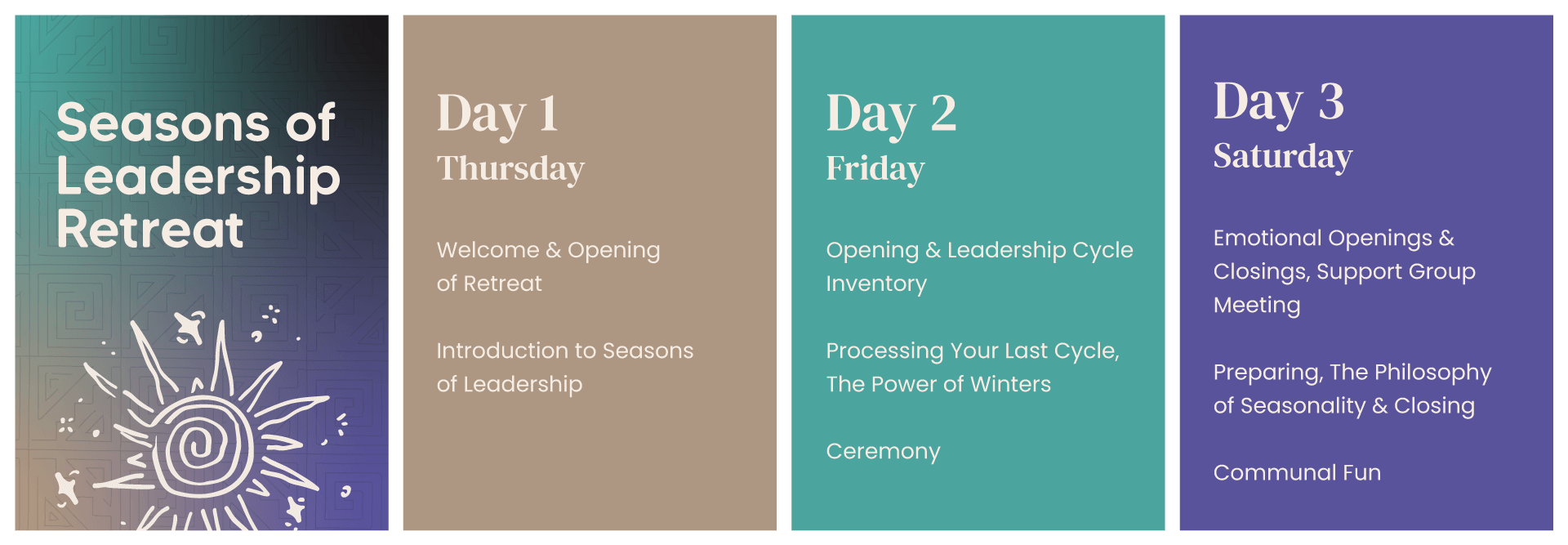
Day 1 Thursday
3:00 pm Welcome & Opening of Retreat
5:00 pm Dinner
6:00 – 8:30 pm Introduction to Seasons of Leadership
- We’ll review the framework of Seasons & Cycles so that everyone has a baseline on the concepts we will be diving into. You will also begin to identify the season you are in.
Day 2 Friday
8:00 am Breakfast
9:00 am – 12:00 pm Opening & Leadership Cycle Inventory
- You’ll take the time to map your leadership journey in order to visualize the ebbs and flows of your last 7 years. Understanding where you’ve been will support in determining where you are going.
12:00 pm Lunch
1:00 – 5:00pm Processing Your Last Cycle, The Power of Winters
- Emotionally process what you went through during your last leadership cycle in small groups. We will also explore the power of Winters and techniques for how to navigate them, as well as what it means if you have not taken a Winter in a long time.
5:00 pm Dinner
7:00 pm Ceremony
Day 3 Saturday
8:00 am Breakfast
9:00 am – 12:00 pm Emotional Openings & Closings, Support Group Meeting
- Understand and protect the season you are in by processing where you’re currently at in your leadership, and understand how the seasons affect your patterns of regulation and disregulation (of being emotionally open or closed). In other words, you’ll gain a macro perspective of what you’ve gone through (and will go through) emotionally through your seasons.
12:00 pm Lunch
1:00 pm – 6:00 pm Preparing, The Philosophy of Seasonality & Closing
- Prepare for the rest of your cycle by creating new habits, identifying support and intentionally undoing/subtracting in order to add more to your leadership. We will also explore how to compliment the season your organization is in and how to navigate any tensions where there is a difference in season (colleagues, organization, movement, etc).
6:00 pm Dinner
8:00 pm Communal Fun
The Practical Stuff
Logistics and COVID Precautions
Dates: You should plan to arrive at 2:00 pm or earlier on April 23rd. We will conclude late on Saturday night (April 25th), so please plan on leaving on Sunday morning, April 26th. We will only accept participants that can attend the whole time, since arriving late or leaving early is disruptive to the cohort.
Daily Schedule: Full days from 9:00 AM to 8:00 or 9:00 PM, with breaks and meals included.
Food: Breakfast, lunch, and dinner are provided by the retreat center.
Location, Lodging & Travel: We will be hosting the Retreat at a beautiful retreat center in the Hudson Valley. It is a beautiful place to gather 2-3 hours from New York airports. Lodging and food will be provided and is included in the cost of the Retreat (shown below). All rooms are shared and any dietary restrictions will be taken into account. If you are accepted, we will be sending you a logistics form from the Center to take your needs into consideration.
You are responsible for figuring out transportation to the Center, however, we can also put you in contact with others traveling to coordinate any carpooling or shuttling from transportation hubs (train or bus station, airport, etc.).
COVID Precautions: We ask that everyone test for COVID before arriving and if you have any symptoms, to please notify us and refrain from coming, since we have folks who are immunocompromised on our team. Thank you in advance!
Retreat Cost Pricing Guide
Below is the cost to attend the Seasons of Leadership Retreat. Please choose your rate accordingly (more information on the difference in tier are below). Payment plans are available upon request (for example, paying over the course of 3 months). Please also note our Reimbursement Policy further below.
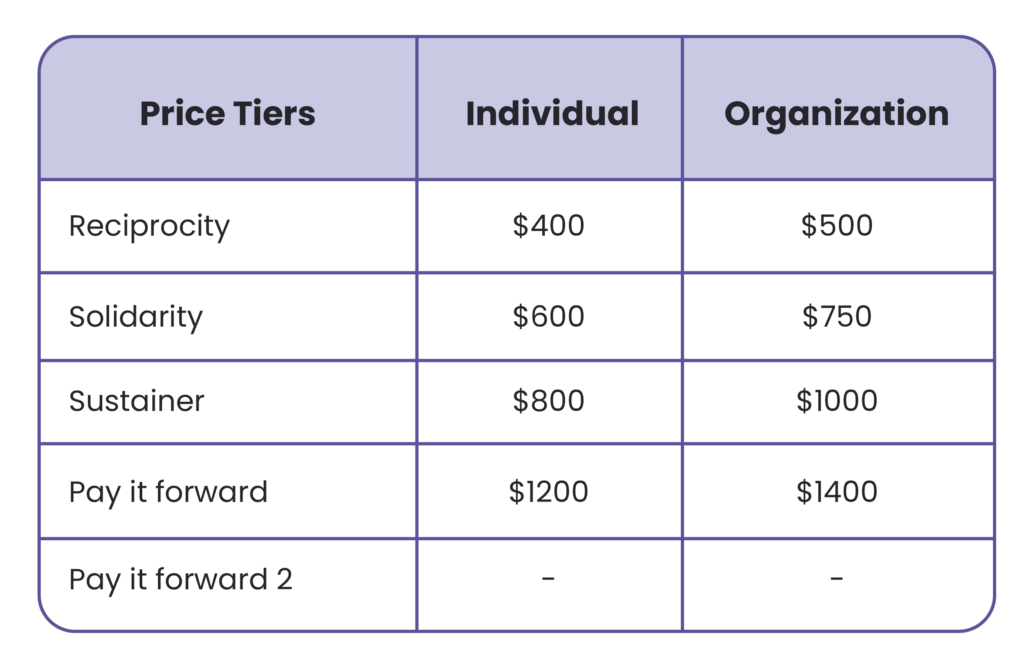
*Payment pan available upon request (for example, paying over the course of 3 months).
Please refer to the next two tabs to check the pricing guides.
Individual Pricing Tiers In-Detail
Essentially, you have a hard time meeting your basic needs, you work in social change, or are not affiliated with an organization that can sponsor your enrollment.
Stability on Meeting Basic Needs
- I am unemployed or underemployed
- I frequently stress about meeting basic needs & don’t always achieve them
- I rent lower-end properties or have unstable housing
- I don’t have transportation and/or have limited access to a car
- I cannot afford a vacation or have the ability to take time off without financial burden
Wealth & Debt
- I have debt and it mostly prohibits me from meeting my basic needs
- I have no access to savings
- I qualify for government assistance including food stamps & health care
- I have no or very limited expendable income
- I rarely buy new items because I am unable to afford them
- I do not have or expect to inherit money or property
Education & Immigration Status
- I may not have completed high school or GED, or have limited experience with higher education
- I do not have U.S. Citizenship & do not qualify for any government assistance
You can meet some of your basic needs but don’t have long-term security. If you identify with all or the majority of the indicators please select this tier.
Stability on Meeting Basic Needs
- I rent lower-end properties but have stable housing
- I have access to transportation or have access to a car
- I am employed, underemployed, living paycheck to paycheck
- I have limited amounts of expendable income
- I don’t often buy new items (but I can if needed) and I thrift other items
- I have very limited funds for a vacation
Wealth & Debt
- I have debt which could prohibit me from meeting my basic needs, but I am currently able to make monthly payments
- I might have access to government assistance or subsidies
- I might have a little savings saved up
- I do not have a safety net composed of “financially stable” or wealthy family and friends
Education & Immigration Status
- I might have attended a community college or public higher education institution
- I have not attended private education institutions or have an advanced degree
- I have work permit, TPS or employee sponsorship providing me some income to meet my basic needs
This is for individuals who are able to meet their basic needs and have the support for long term financial stability and ability to pay the actual cost without being financially burdened.
Stability on Meeting Basic Needs
- I own or lease a used or lower end car & have access to transportation
- I am employed/have stable income
- I have access to health care (private or public) & don’t rely on government benefits
- I can take a vacation annually or every few years without financial burden
- I qualify for first time home buyers programs or subsidies to purchase a house or property
Wealth and Debt
- I might have debt but don’t usually stress about meeting my basic needs and regularly achieve them
- I have access to financial savings
- I have expendable income
- I am able to buy mostly new items
- I am expecting to inherit small amounts of money or property
Education and Immigration Status
- I have U.S. Citizenship or other citizenship that allows me freedom of mobility
- I might have private education institutions or have an advanced degree
This tier is for higher-earning individuals that can meet all of their basic needs, have support for long term financial stability, has built wealth with the ability to share their abundances.
Stability on Meeting Basic Needs
- I am comfortably able to meet all of my needs & desires
- I own my home or property OR I rent a higher-end property
- I own or lease a higher end or multiple car(s)
- I have regular access to health care
I am employed or do not need to work to meet my needs - I have a safety net composed of “financially stable” or wealthy family and friends
Wealth and Debt
- I have access to financial savings & access to wealth
- I have an expendable income
- I can always buy new items
- I can afford an annual vacation or take time off when needed
- I own property or multiple properties
- I have and/or expect to inherit significant money or property
Education and Immigration Status
- I have attended a private education institution or have an advanced degree
- I have U.S. Citizenship or other citizenship that allows for mobility around the world
After reviewing the tier qualifiers, please select the one you self-identify with and the price rate that applies to your tier. Things to consider when reviewing the following tiers:
The following is our guide to help you think about what rate you qualify for and doesn’t encompass all of your personal factors.
Please make sure to consider any personal financial responsibilities; work, family, health, etc. when selecting your tier.You do not have to meet all the factors to fall into a category. Instead, these should be guideposts to help you think about what tier you qualify for. If most of the qualifiers describe you or your situation, you are in that tier.
Organization Pricing Tiers In-Detail
If you are an emerging, nascent organization within your first 3 years, or under resourced with a budget under $150K, your organization falls under this tier.
You are a small to midsize organization with a budget ranging from $150 – $600 K.
Your are an established organization with a budget within the range of $600 – $1.5 million annually.
You are a stable organization with a budget of $1.5million+.
You are a stable organization with a budget of $5million+.
Reimbursement Policy
For In-Person and Online Trainings