Overview
Since its origins in the 1960s Latin American liberation movements, Participatory Action Research (PAR) has seen a proliferation of interest. PAR is a critical and spiritual form of research and social change that engages everyday people in the process of knowledge construction. We define PAR as:
Oppressed people collectively work to generate knowledge by interrogating the conditions of their exploitation and then use their own knowledge to LIBERATE THEMSELVES.
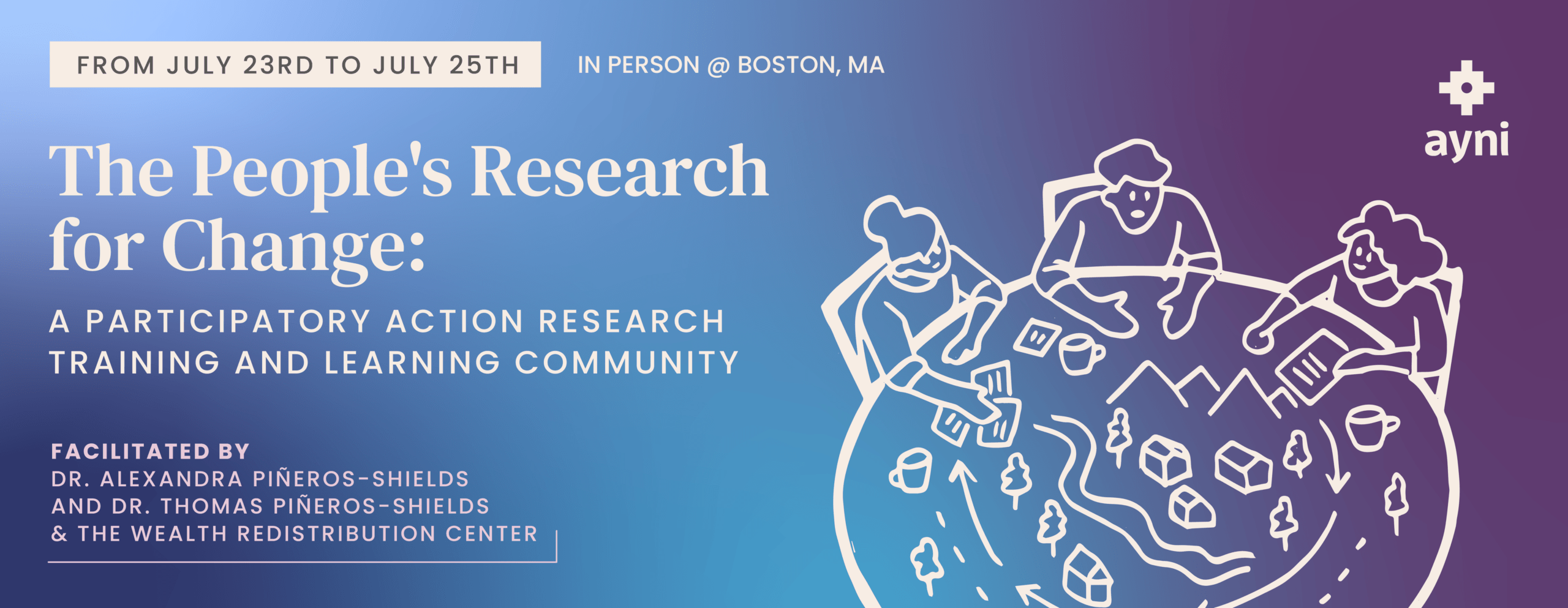
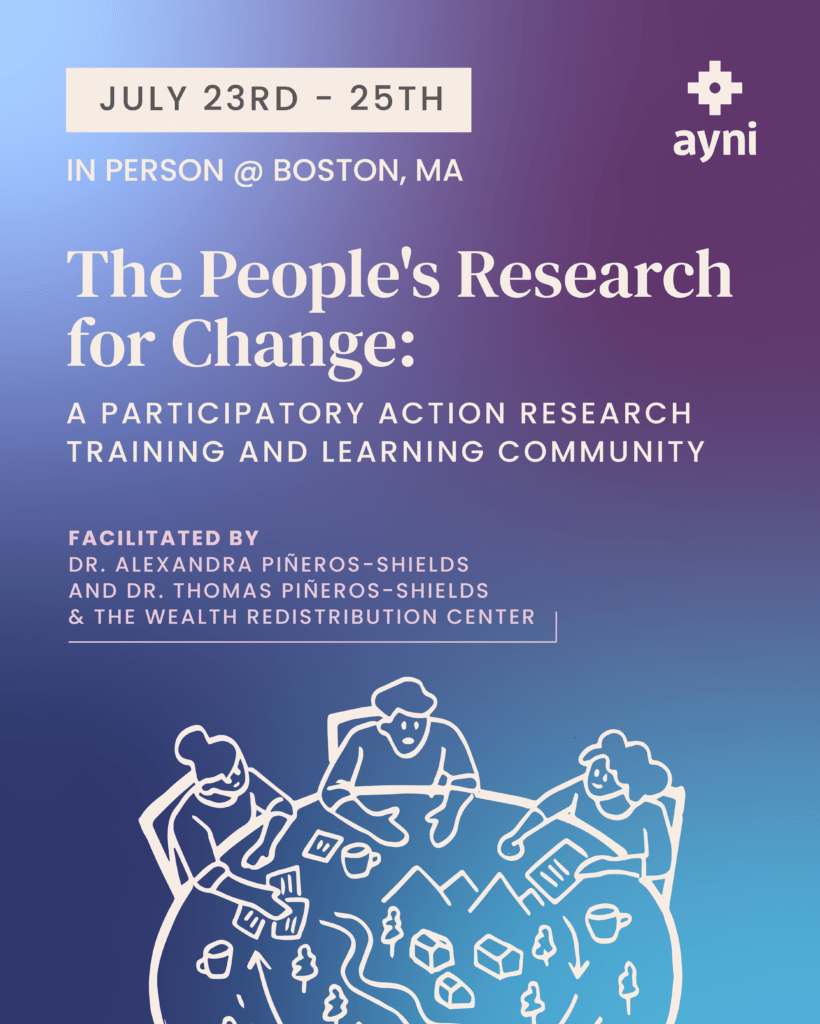
Between July and December 2026, we will host a Learning & Action Community for up to 5 teams of 4-6 members each who wish to pursue community-driven PAR strategies in their own communities. Participating teams are expected to attend a three day in-person training July 23-25th at the Ayni Institute in Revere, MA. Each team will then be eligible to receive a $1000 stipend to help carry out their research plans when they return to their home communities. The teams will present the results of their projects at a virtual symposium in December 2026.
This event will be co-sponsored with the Wealth Redistribution Center.
Goals
- During a virtual orientation meeting on Wednesday June 24th 3:00pm-5:00pm, participants will be introduced to community-driven PAR, including its history and approaches to liberation movements.
- During the three-day in-person workshop, teams will gain practical skills and develop a plan to carry out a PAR project.
- Between July and December, participating teams will implement PAR projects in their home communities with technical support from the facilitators through monthly virtual meetings ; and
- Together we will build a learning community of PAR practitioners dedicated to knowledge production and our mutual liberation.
Modalities
Online Orientation Meeting (June 24th, 2026, 3-5pm)
During a virtual orientation meeting on Wednesday June 24th 3:00pm-5:00pm, participants will be introduced to community-driven PAR, including its history and approaches to liberation movements.
In-person Team Training (July 24th - 26th)
Attendees attend in-person training as a team with at least two co-researchers from the same community or organization to design a realistic and implementable PAR project that they will carry out once they return to their home community.
Online monthly Learning & Action Community meetings (July-December)
We will continue to hold space for each team. Teams will receive individualized coaching once a month as they conduct data collection and engage in data analysis
Learning & Action Community Symposium (After 2026).
After the showcase, we will facilitate the process of amplifying voices of the PAR research teams through the option to showcase and disseminate lessons from their PAR projects.
Overview
Since its origins in the 1960s Latin American liberation movements, Participatory Action Research (PAR) has seen a proliferation of interest. PAR is a critical and spiritual form of research and social change that engages everyday people in the process of knowledge construction. We define PAR as:
Oppressed people collectively work to generate knowledge by interrogating the conditions of their exploitation and then use their own knowledge to LIBERATE THEMSELVES.
Between July and December 2026, we will host a Learning & Action Community for up to 5 teams of 4-6 members each who wish to pursue community-driven PAR strategies in their own communities. Participating teams are expected to attend a three day in-person training July 23-25th at the Ayni Institute in Revere, MA. Each team will then be eligible to receive a $1000 stipend to help carry out their research plans when they return to their home communities. The teams will present the results of their projects at a virtual symposium in December 2026.
This event will be co-sponsored with the Wealth Redistribution Center.
Goals
- During a virtual orientation meeting on Wednesday June 24th 3:00pm-5:00pm, participants will be introduced to community-driven PAR, including its history and approaches to liberation movements.
- During the three-day in-person workshop, teams will gain practical skills and develop a plan to carry out a PAR project.
- Between July and December, participating teams will implement PAR projects in their home communities with technical support from the facilitators through monthly virtual meetings ; and
- Together we will build a learning community of PAR practitioners dedicated to knowledge production and our mutual liberation.
Modalities
Online Orientation Meeting (June 24th, 2026, 3-5pm)
During a virtual orientation meeting on Wednesday June 24th 3:00pm-5:00pm, participants will be introduced to community-driven PAR, including its history and approaches to liberation movements.
In-person Team Training (July 24th - 26th)
Attendees attend in-person training as a team with at least two co-researchers from the same community or organization to design a realistic and implementable PAR project that they will carry out once they return to their home community.
Online monthly Learning & Action Community meetings (July-December)
We will continue to hold space for each team. Teams will receive individualized coaching once a month as they conduct data collection and engage in data analysis
Learning & Action Community Symposium (After 2026).
After the showcase, we will facilitate the process of amplifying voices of the PAR research teams through the option to showcase and disseminate lessons from their PAR projects.
Training Development
Phase I
Learning & Action Community and Team: Recruitment, Selection, and Orientation
We will begin national recruitment for teams from social movement and community-based organizations who seeks structural change through knowledge production and action in April 2026. Ideally teams of approximately 5 members will sign up together. Note that some teams may be 6, while others can be 3 or 4. Also, we are open to individuals who sign up for the July training, and they will be assigned to join either existing teams or form a team for the purposes of in person training. We will begin to select applicants May 15, 2026 through a process that may include interviews. Teams will be informed of their selection no later than June 1, 2026.
Virtual Orientation Meeting June 24, 2026, 3:00-5:00pm EDT.
In May, selected participants will be sent a reading packet to prepare for the PAR Learning & Action Community retreat, which will guide orientation discussions. The online conversation will be 120 minutes long. The purpose of this orientation / discussion meetings will be (1) to begin to establish a shared understanding of PAR among members of the Learning & Action Community and (2) to begin to build a community of learners before the in-person training
Phase II
In-Person PAR Team Training Agenda July 24th-26th, 2026.
In this three-day interactive workshop, participants will gain the tools and work together to design a participatory research project.
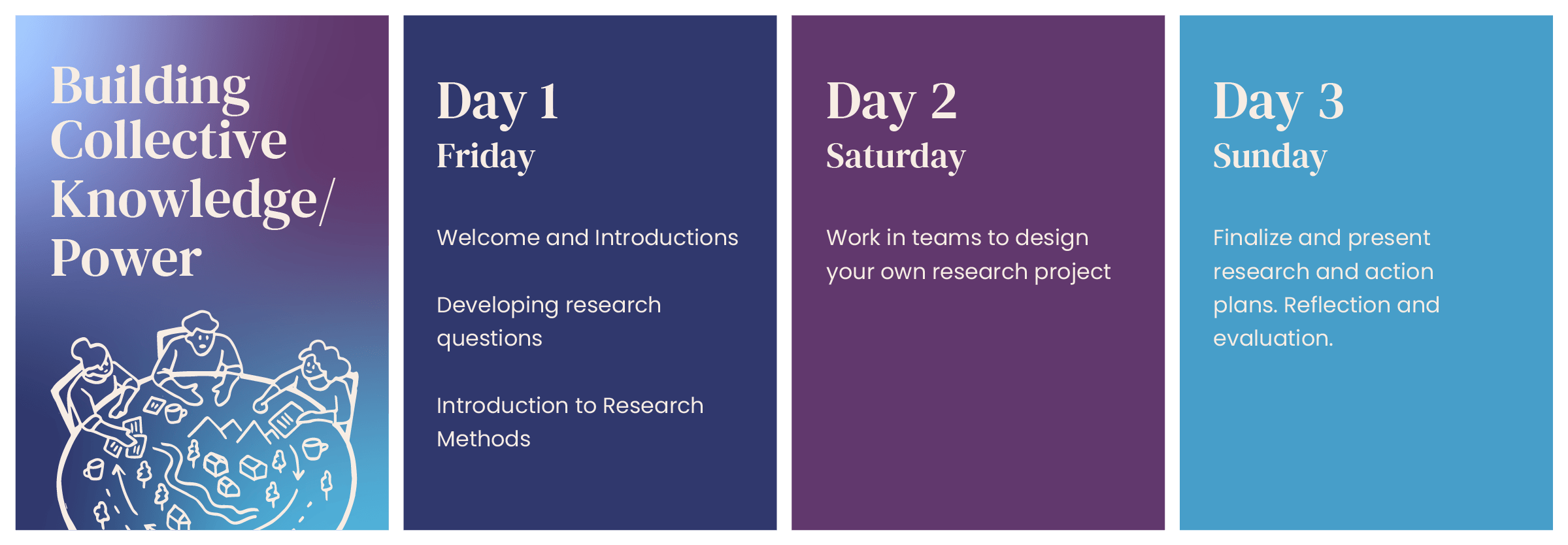
Friday July 24, 2026
1:30pm Gather at Ayni
Light A light lunch provided
Welcome and Introductions
- Community building exercises
- Present a case of an exemplary community-driven PAR project that led to significant social change.
Developing research questions.
- We will use the Question Formulation Technique (QFT) to learn to develop research questions.
Introduction to Research Methods – Teams will learn and apply research methods through hands-on practical exercises. This might include some combination of:
- Ethnography (Mental mapping activity, Ethnography 101, PhotoVoice, etc.)
- Talking to people (Interviewing 101 or Focus groups).
- Surveys/polls
- Existing data
End by 5:30pm
Dinner on your own.
Saturday July 25, 2026
Morning
Gather at Ayni 8:30am – Breakfast provided
9:00am
Continue and/or reporting on research methods practice from Friday evening.
Noon – Lunch on site at Ayni
Afternoon
Work in teams to design your own research project.
- Analysis to make sense of data and planning action
- Qualitative
o Analyzing text: themes and narratives
o Visual and audio data
- Quantitative
o Statistics for every day.
o Making sense of numbers, charts, graphs
- Action planning: Participants will explore strategies to make change through knowledge production.
End at 5:30pm
Dinner on your own.
Sunday: Presenting research and action plans
Morning – Gather at Ayni
Breakfast provided
Finalize and present research and action plans. Reflection and evaluation.
11am-12:30am. Looking ahead to the Learning & Action Community meetings.
Ending at 12:30pm
Phase III
Mini-Grants
Before August 1, 2026 and based on the proposals presented on the last day of the in-person training in June, up to 5 teams will be selected to receive $1,000 mini-grants to implement their PAR projects between July and December 2026.
Monthly Learning & Action Community Meetings
We will hold space for monthly meetings to form learning and action communities. The purpose of learning and action community meetings will be to support each team as they carry out PAR projects in their home communities in the months after participation in in-person PAR training.
December 2027 Final Symposium
All projects teams will be invited to present their projects in a virtual showcase in December 2027. The results maybe compiled into either 5 separate short publications and/or video if teams wish to participate.
The Trainers
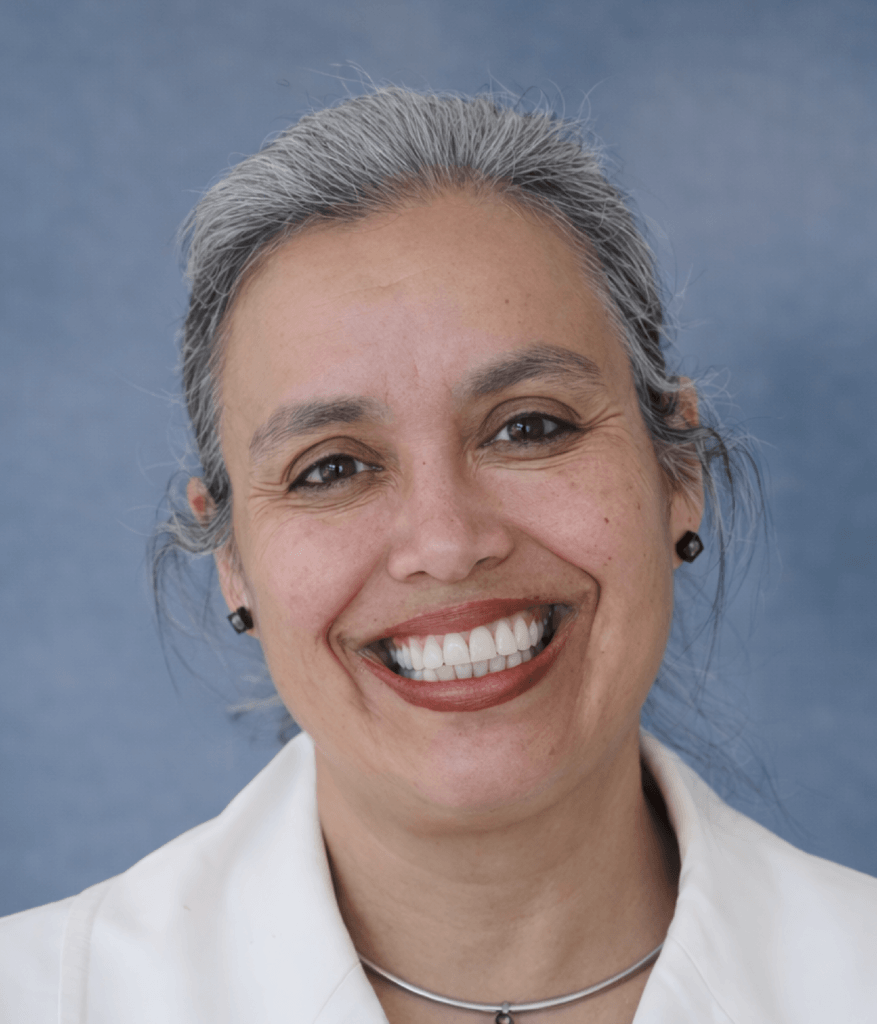
Alexandra Piñeros-Shields, Ph.D. identifies as a Midwife for Power and has organized in Latino communities for many years. Currently, she is an Associate Professor and directs the Master of Public Policy Program at the Heller School, Brandeis University. She teaches courses on immigration policy, economic justice, and participatory action research. Prior to joining the Heller faculty, she was the Executive Director of the Essex County Community Organization (ECCO), an interfaith network of 40 congregations organizing for racial and economic justice. Over her 35-year career in the Boston area, Dr. Piñeros-Shields has worked with Black and immigrant communities to dismantle the systems of mass incarceration in the criminal legal system and the immigrant detention system. Dr. Piñeros-Shields serves as Chair of the Board of the Massachusetts Budget and Policy Center and on the Boards of the ACLU of Massachusetts and Philanthropy Massachusetts.

Thomas Piñeros-Shields, Ph.D. is an Associate Professor of Politics, Policy and International Relations (PPIR) at Salem State University and the founding director of the North Shore Policy Lab where he engages students in participatory community-based research and learning projects. For over three decades, Dr. Piñeros-Shields engaged in action research projects in Ithaca and Queens, NY, East St. Louis, IL, Waltham, MA, Lowell, MA, and with the Student Immigrant Movement (SIM). For over twenty-five years he has also managed and conducted mixed-method applied research and evaluation projects to prove and improve youth-based community programs in the areas of civic engagement and service-learning. Dr. Piñeros-Shields earned an undergraduate degree from Cornell University, a master’s in Urban and Environmental Policy from Tufts University. He earned his doctorate in the joint Sociology/Social Policy program at Brandeis University with his dissertation that explained how DREAMers emerged as new political actors, based on a 5-year ethnography of the Student Immigrant Movement (SIM) between 2008 and 2012
What We Need From You
Costs for In-Person Training
As noted above, the in-person training will take place at the AYNI Institute between July 24 and 26th (See full schedule). Breakfast, lunch and snacks will be provided as well as training materials.
Teams are invited to apply to attend in-person training with at least three co-researchers from the same community or organization to design a realistic and implementable PAR project that they will carry out once they return to their home community.
The cost for attending the in-person training will be $300/team of three with $50 for each additional team member.
We will consider individuals to the application process at a sliding scale cost starting at $150 per person, plus any additional gifts to the AYNI Institute that they would like to contribute.
Attendees who successfully complete the training will receive a certificate of completion.
Five teams will be eligible to receive a $1,000 mini-grant and six months of coaching to implement their proposed PAR projects.
Criteria for Application
Space is limited and we only have funding to award mini-grants to five teams. We may consider additional attendees at the in-person training who just want to learn about PAR.
We will select applicants based on the following criteria:
- An initial idea of a clear and compelling issue or set of issues (social problem) defined by members of their community that would benefit from the PAR process.
- Demonstrate the capacity to carry out a collective project in their home community.
- You need to believe in or be open to the process of democratizing knowledge construction and applying that collective knowledge to action for social change.
- A spirit of respect and openness. We’re going to have people from different backgrounds, working on different issues, and that diversity is a strength.
- A commitment by at least 3 team members to attend the virtual orientation in June, all days of the in-person training (July 24-26) and monthly check-in individual coaching sessions with the facilitators.
- Willingness to commit at least 5 people to implement a PAR project between July and December and share results at the December virtual meeting.
Who should be on a team?
Teams should ideally consist of approximately 5 members (give or take 1-2) who are closest to a social condition or problem that they want to investigate and develop a strategy to address. Those who are closest to a given issue tend to understand the issue best. People with expertise such as lawyers, college professors, scientists, philanthropists or others can be part of the team, but need to be willing to “check” their assumptions in the face of the lived experiences of people who are closest to the issues in their communities. In other words, PAR rests on the assumption that we all bring knowledge, skills and resources to the table.
What issues should we work on?
The PAR process is one of community building, action and knowledge production. The key is that members of the community who are closest to the problem choose the issues and/or define the research question. Teams should choose a pressing issue that members of their community feel they want to investigate in order to decide how to begin to take action. We will work with you at the in-person retreat to define your project and research question. You should develop a project that can be launched within the timeline (July- December 2026).